The chin is shifted to the side
The chin deviates from the middle of the face. Among patients with asymmetry in the examination of 1,460 people, the chin was displaced in 74%.
 Discuss your case
Asymmetry of the face and jaws is a noticeable difference between the left and right halves of the face when the jaws, teeth, or soft tissues are misaligned. Slight asymmetry is common and considered normal; treatment is considered when it is noticeable, increases or interferes with chewing.
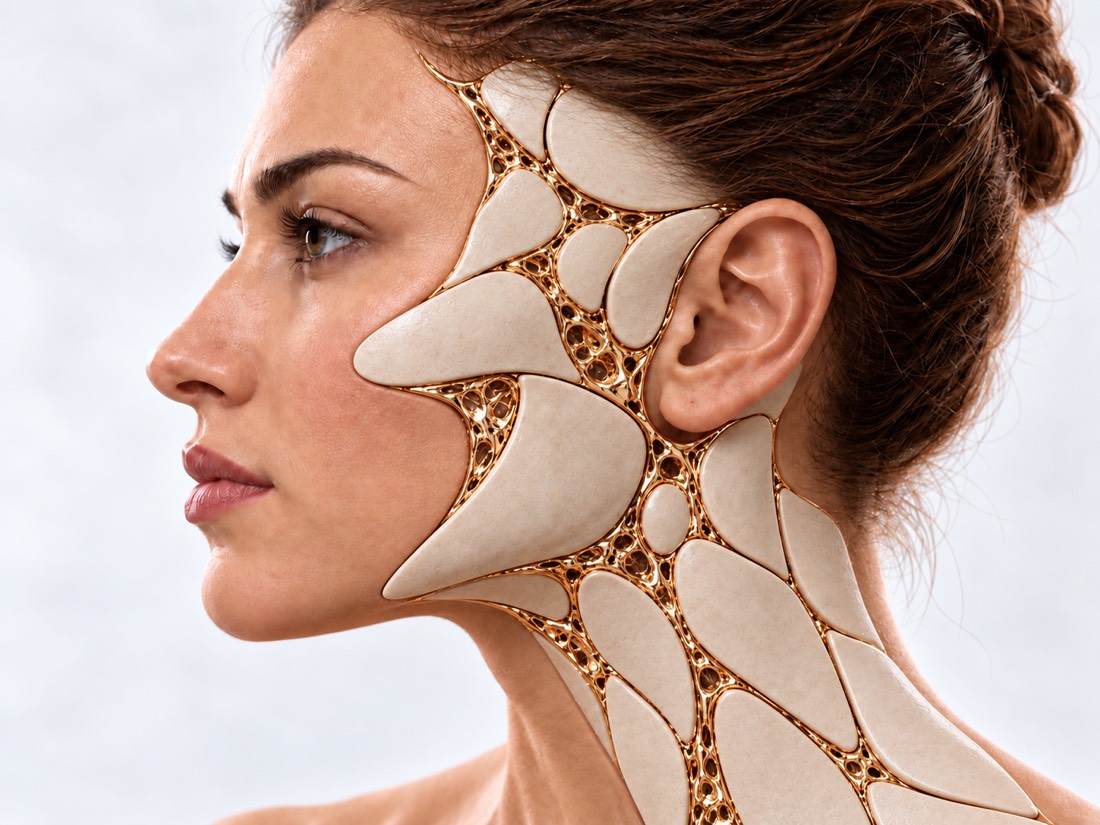 CONCEPTUAL VISUALIZATION
A completely symmetrical face is rare: a slight difference between the halves is common and often imperceptible. Asymmetry is considered a problem when the difference is noticeable to the eye, interferes with chewing or closing the teeth, or gradually increases.
The difference can come from bones (lower or upper jaw, condyle, which connects the jaw to the skull), from teeth and bite, or from soft tissues - fat, muscles, skin. Often there are several components at once: the teeth close with a shift, the line between the front teeth is shifted, and the plane along which the teeth close is inclined.
First, they find out the cause, because the treatment is primarily aimed at it. If the asymmetry is combined with an incorrect bite, the jaws are rearranged during orthognathic surgery; the volume of bones and soft tissues on one or both sides is sometimes additionally increased or decreased.
This is general information. The doctor will tell you what will suit you after the examination.
Soft tissues, teeth and bones are evaluated separately. People do not notice asymmetry in the same way: according to a review of studies, the difference in the position of the eyelids is visible from 2 mm, the corner of the mouth - from 3 mm, and the shift of the chin - from about 6 mm.
The chin deviates from the middle of the face. Among patients with asymmetry in the examination of 1,460 people, the chin was displaced in 74%.
The line between the front teeth does not coincide with the middle of the face, on one side the teeth close differently than on the other.
Mesial biteThe plane on which the teeth close is inclined: in a smile, more teeth or gums are visible on one side. 41% of patients with asymmetry in the same examination had this inclination.
One cheek or the corner of the jaw is fuller, the other half seems sunken - this is how soft tissue or bone asymmetry manifests itself.
Clicking, pain or limited mouth opening on one side. According to a meta-analysis of 7 studies, unilateral temporomandibular joint disease is associated with chin asymmetry, although the evidence is low.
Dysfunction of the jointThe causes are congenital, acquired, post-traumatic and growth-related. The treatment plan also depends on the cause.
One half of the face — jaw, ear, soft tissues — is underdeveloped from birth.
Hemifacial microsomiaThe condylar process of the lower jaw on one side grows more than it should, and the jaw shifts or lengthens. Deformation can grow even after 20 years. In Germany, 2.4–9.6 cases per 100,000 people are diagnosed or treated.
Displaced fractures of the jaws or cheekbones change the contour of the face and bite.
Deformations after injuriesFusion or destruction of the temporomandibular joint on one side changes the growth and position of the jaw.
Ankylosis of the jointWith progressive hemiatrophy (Parry-Romberg disease), the subcutaneous layer of one half of the face gradually thins. Asymmetry is also caused by paralysis of the facial nerve.
Paralysis of the facial nerveThe reasons for many cases of asymmetry formed during growth cannot be clarified.
The asymmetry, which has been forming for years, does not need urgent help. But if the face is suddenly crooked, it could be a stroke - call 103.
Immediately - to the surgeon who operated, and if it does not work - to the waiting room: after surgery, the pain or swelling of the face is severe or increases, and painkillers do not help. On the same day - call the surgeon: after surgery, pus comes out of the wound or mouth, the suture has come apart, you have a fever, or you feel generally unwell. Scheduled, without delay: asymmetry noticeably increases - especially in a teenager or young person - the teeth began to close differently, clicking or joint pain appeared. Early diagnosis of excessive growth of the condyle makes it possible to stop the progression. A long-standing stable asymmetry is a reason for a regular planning consultation.
When asymmetry was noticed, whether it is growing, whether there were injuries and operations. Photos from different years help.
The doctor separately evaluates soft tissues, bite and bones, checks movements and sounds in the joint.
The pictures show which bone is displaced and how much; CT gives a three-dimensional picture.
If excessive growth of the condyle is suspected, scintigraphy (SPECT) is performed - it shows whether the bone is still growing.
They build a model of the face and jaws based on the CT scan and plan what to move on it.
Treatment depends on age, cause and severity of asymmetry — from orthodontics to jaw surgery. The goal is a noticeably flatter face and proper teeth closure, not complete mirror symmetry.
Treatment is primarily aimed at the disorder that caused the asymmetry.
If the asymmetry is combined with an incorrect bite.
Bone surgery is supplemented or asymmetry is corrected without changing the bite.
Asymmetry of the face and jaws at Dr. Valikhnovskyi's Institute of Surgery is treated in the direction of "New face" - together with deformities after injuries and reconstruction of the jaws. Whether an operation on the jaws or on the joint is required, the surgeon decides after the CT scan; an orthodontist takes care of the teeth before and after the operation.
Plastic surgeon, candidate of medical sciences, founder of Dr. Valikhnovskyi Institute of Surgery.
Short answers. What is right for you, the doctor will tell you during the consultation.
Yes. Slight asymmetry is common and considered normal. According to a review of studies, the displacement of the chin begins to be noticed from about 6 mm.
If only the teeth are asymmetric, sometimes orthodontics is enough. Bone asymmetry with an incorrect bite is corrected by surgery on the jaws, and the lack of volume is corrected with an implant or lipofilling.
One of the reasons is the excessive growth of the condylar process: the deformation can increase even after 20 years. Early diagnosis makes it possible to stop the progression.
The implant aligns the contour, but does not change the bite. If the teeth do not close properly, jaw surgery is usually required, and an implant only complements it.
This is possible. After sagittal osteotomy of the lower jaw, sensitivity of the lip and chin may decrease; according to a meta-analysis of 47 studies, 21% of patients remained impaired after a year.
To see in advance on the model where and how much to move the bones, and to print templates for the operation. The average soft tissue prediction error in the review of studies was less than 2 mm.
Call 103: it could be a stroke. Sudden asymmetry is not the planned jaw asymmetry that this page is about.
The figures on the page are from these sources.
Submit full-face and profile photos and headshots, if available. The doctor will tell what causes the asymmetry and what can be changed.
Leave your contact details and briefly describe the situation. A coordinator will contact you to agree on the next step.