CONDITION / JAWS, MOUTH AND NECK

Underdeveloped chin (microgenia).

An underdeveloped chin, or microgenia, is a small or tilted back chin, when the lower jaw itself and the bite are mostly normal. This also includes depressions and irregularities of the lower jaw after injuries or operations. They are corrected in a planned way - with bone, implant or own tissues.

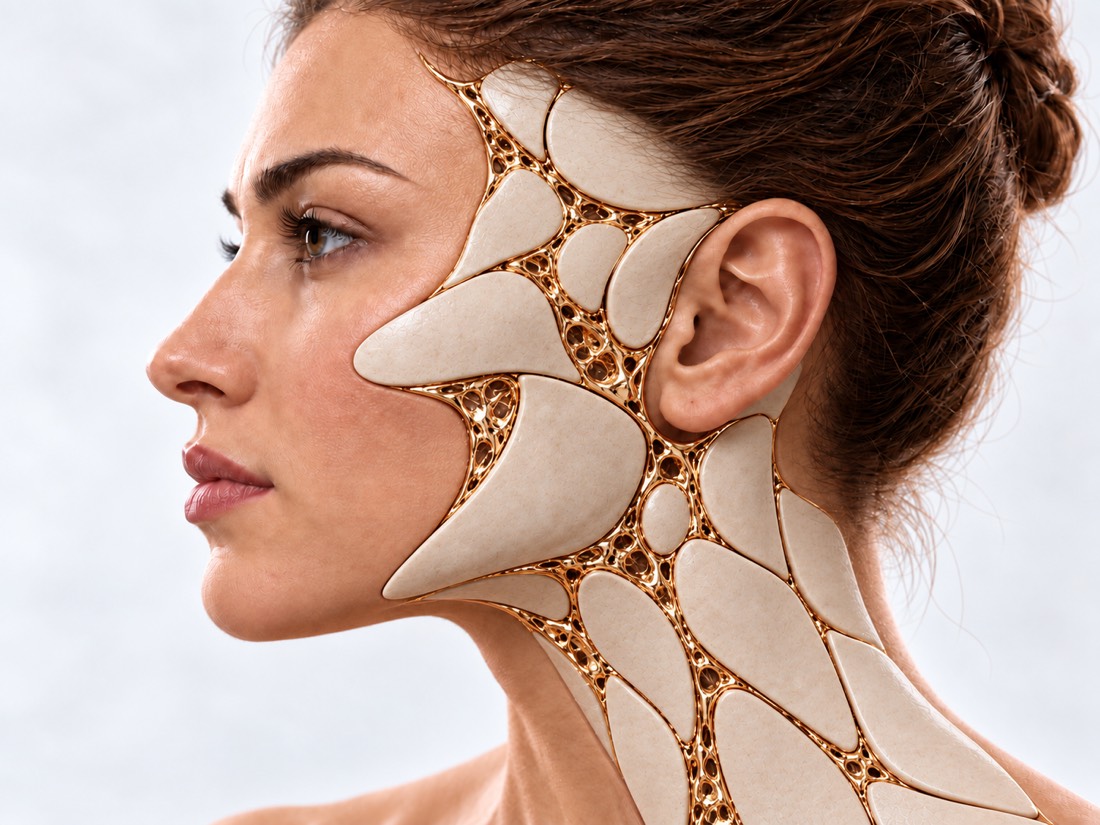
Conceptual visualization: contour of the chin and lower jawCONCEPTUAL VISUALIZATION
What it is
A small or sloping chin or depression in the lower jaw when the bite is mostly unchanged.
What is being corrected?
By moving the chin bone, implant, own bone, cartilage or fat.
What is known
No method has proven a clear advantage — the choice depends on the shape of the defect, tissues and risks.
Who treats it
Maxillofacial or plastic surgeon; if the bite is changed, together with the orthodontist.

What is
microgenius

The chin is the front part of the lower jaw. The appearance of the lower third of the face, especially in profile, depends on its position. Microgenia is a condition when the chin itself is small or recedes back, and the jaw in general and the teeth are in their place.

If the entire lower jaw is underdeveloped and the teeth close incorrectly, this is a different condition, and the treatment plan is different: the jaw is moved together with the teeth. Therefore, first the doctor determines what exactly has changed - the chin, jaw or bite.

Contour defects are depressions, steps, or irregularities of the lower jaw that remain after fractures, removal of cysts and tumors, or previous operations. They are leveled in the same planned manner, selecting the material for a specific defect.

This is general information. The doctor will tell you what will suit you after the examination.

How is it
looks

A small chin is clearly visible in profile, and contour defects are visible to the touch and in pictures.

01

Slanted chin

In profile, the chin recedes back relative to the lips, the transition from the chin to the neck is unclear.

02

The bite is normal

The teeth close correctly. If the lower teeth are noticeably behind the upper ones, the reason may be in the entire jaw.

Distal bite
03

A depression or a step

A depression, step or unevenness can be seen or felt on the edge or corner of the lower jaw.

04

Different contour on two sides

The angle or edge of the jaw on one side is different than on the other, the chin is shifted to the side.

Asymmetry of the jaws

Where does it come from?
microgenia and defects.

A small chin is simply a feature of the facial structure. Contour defects usually have a clear cause.

Face structure

The chin is naturally small or recedes, although the jaw and teeth are normally developed.

Underdevelopment of the jaw

Sometimes a small chin is part of congenital underdevelopment of the lower jaw.

Hemifacial microsomia

Fracture

A mandibular fracture that has grown together with a displacement leaves a step or a displaced contour.

Deformations after injuries

Removal of a cyst or tumor

After the removal of part of the bone, a depression may remain on the jaw.

Jaw cysts

Preliminary procedures

A dislodged implant or filler inserted into the chin can change the contour.

Effects of fillers

When to seek medical advice?

A small chin and long-standing contour defects do not require emergency care - they are treated on a regular basis. Urgent help may be needed only after surgery or filler injection.

103 immediately if:

  • swelling in the mouth, under the tongue or on the neck grows quickly and makes it difficult to breathe or swallow;
  • blood gushes, bright red, it is difficult to stop;
  • bleeding from the mouth or wound does not stop;
  • a person is suffocating, it is very difficult for him to breathe or utter words;
  • the skin or lips are pale, bluish or marbled;
  • very frequent breathing;
  • the body is very hot or cold to the touch, shakes a lot;
  • confusion, the person speaks illogically;
  • during or after the injection of the filler, vision suddenly worsened or disappeared, double vision in the eyes.

Other levels of urgency:

Immediately - to the surgeon who operated, and if it does not work - to the waiting room: the pain or swelling of the chin is severe or increasing, and pain relievers do not help. Immediately - to the doctor who injected the filler, and if it does not work - to the waiting room: after the injection, the skin on the chin turns white or blue, a purple mesh appears, or it hurts a lot. On the same day - call the surgeon: the wound in the mouth or under the chin becomes redder and hurts more and more, pus is released from it, the suture has come apart, the implant is visible through the wound, the temperature has risen or you feel generally unwell. Planned: numbness of the lip and chin after surgery - tell the surgeon about it at the follow-up examination; a small chin or a hollow on the jaw - make an appointment for a consultation when it's convenient.

As defined,
what to fix

  1. Conversation

    What exactly bothers you, whether there were injuries, surgeries, implants or fillers in the chin.

  2. Overview of profile and bite

    The doctor separately evaluates the chin, lower jaw, lips, and closing of the teeth.

  3. Photo in standard angles

    Full-face and profile — for planning and comparison.

  4. CT

    Shows the shape and thickness of the bone, the position of the chin nerve and the size of the defect.

  5. 3D planning

    Based on the CT scan, a model is built and it is used to select how much to move the bone or what shape to make the implant.

How to fix
chin and contour.

In a systematic review of 56 studies (4,844 patients), no method was clearly superior and the quality of the evidence was limited. Therefore, the method is selected individually - according to the shape of the defect, tissues and risks that a person is ready to accept.

01

Chin bone

Genioplasty — moving one's own bone.

How do they do it?
The lower part of the chin is sawed off, moved forward, down or to the side and fixed with a plate.
Sensitivity
Temporary changes in the sensitivity of the lip and chin after genioplasty occur often, in some studies - in all patients; they remained stable in 7.4–12.5%.
Complications
In a review of 54 studies, the overall frequency of complications after chin osteotomy was 19.7%, of which temporary disorders of the chin nerve were 16.4%.
Stability
Soft tissues replicate bone movement better than after an implant (85% vs. 66%). Part of the result may return over time: the recurrence rate in various studies is 2.63–27.21%, slightly higher than after implants.
02

Implant

Standard or individual - without sawing the bone.

Standard implant
Silicone, porous polyethylene (Medpor) and other materials. In a review of 54 studies, the overall frequency of complications after implants was 15.7%, temporary nerve disorders — 2.4%.
Infection and wound
After implants, infection (up to 23.8% in various studies) and wound dehiscence occur more often. Violations of sensitivity occurred more often with porous polyethylene (20.1%) than with silicone (0.4%).
Individual implant
Titanium or PEEK according to the 3D model — for defects of non-standard shape. In a meta-analysis of 29 studies (392 patients), the complication rate was 6.94% for PEEK and 4.77% for titanium.
03

Own fabrics

Bone, cartilage, fat or dermis.

Bone and cartilage
They can provide support and take root, but there is little data and they are heterogeneous.
Fat and dermis
The contour of soft tissues is smoothed, but the volume is kept less predictably: after fat, repeated lipofilling is needed, the dermis has been resorbed by about 35% in a year. The true frequency of complications of facial lipofilling is unknown.
04

Large jaw defects

When a significant part of the bone is missing, for example after the removal of a tumor.

Bone from the lower leg
A fragment of the fibula with its own vessels is transferred to the jaw. In a meta-analysis of 257 patients after oncological operations (bone from the leg or from the pelvis), speech was more fully restored of all functions, and chewing was worst of all.
Virtual planning
In a meta-analysis of 6 studies, the angle of the jaw after reconstruction according to the virtual plan deviated from the planned one by an average of 3.6°, without it - by 7.7°.
05

Without surgery

Fillers
Hyaluronic acid or calcium hydroxyapatite change the contour quickly, but the data are mostly short-term. Side effects are mostly temporary (swelling, bruising, pain), but rare serious vascular complications occur.

How
we treat it.

At Dr. Valikhnovskyi's Institute of Surgery, contour defects of the lower jaw and small chin are corrected by the New Face team, which restores jaws after injuries and tumor removal. The surgeon selects the method after examination and CT scan; if the bite is changed, the teeth are treated by an orthodontist.

CLINIC SERVICE A new face Form, symmetry, facial expressions and functions after injuries, wounds, burns, removal of tumors and congenital changes. View service

What we do for this condition

  • Virtual planning and 3D printing — a three-dimensional model of the jaw is built using a CT scan and a correction is planned in advance.
  • Mirror CT modeling — if the defect is on one side, the healthy half is mirrored and a contour plan is obtained.
  • Individual implants made of titanium or PEEK — fragments of the jaw according to the 3D model, repeating the anatomy of the patient.
  • Surgical templates — printed guides, along which the bone is sawn at a given angle.
  • Implant or graft for the contour — align the contour of the bone that grew with the displacement after the fracture.
  • Fibula flap — for large defects of the lower jaw — the leg bone with its own vessels.
  • Lipofilling — own fat for correcting contours after reconstruction.

Rostislav Valikhnovskyi

Plastic surgeon, candidate of medical sciences, founder of Dr. Valikhnovskyi Institute of Surgery.

How treatment works with us

  1. Photo onlineSend a full-face and profile photo, as well as a CT scan, if available - the doctor will pre-evaluate the situation.
  2. ConsultationExamination of the chin, jaw and bite; if necessary — CT.
  3. PlanWhat has changed, what material to align with, whether 3D planning and an orthodontist are needed.
  4. SurgeryContour correction by the selected method.
  5. RecoveryThe chin swells most strongly in the first days, the main swelling subsides in a few weeks; for a while, the food is soft, do not smoke - it worsens the healing.

Common
questions

Short answers. What is right for you, the doctor will tell you during the consultation.

How does microgenia differ from a distal bite?

With microgenia, the chin itself is small, and the teeth close correctly. If the entire lower jaw is underdeveloped and the bite is incorrect, the jaw is moved together with the teeth - this is another operation.

Which is better: an implant or your own bone?

There is no clear answer: research reviews have not identified a clearly superior method. Changes in sensitivity are more common after bone displacement, infection and wound separation after an implant. The method is selected individually.

Will the lip be numb after surgery?

Temporary numbness of the lip and chin after genioplasty is common. It remained stable in 7.4–12.5% ​​of patients, according to a review of studies.

Is it possible to increase the chin with a filler?

Yes, this is a non-surgical method: the contour changes quickly, but the data on the result are mainly in the short term, and after operations the changes are slower. Side effects are mostly temporary, but there are rare serious vascular complications.

Will the fat "suck out"?

Volume retention after fat is less predictable than after bone or cartilage; sometimes repeated lipofilling is required.

Is it possible to straighten the hollow on the jaw after removing a cyst or tumor?

Yes. Small defects are leveled with an individual implant, own bone or fat, large ones with bone from the lower leg on own vessels. First, the doctor assesses the defect on a CT scan.

Sources

14 sources · reviews, guidelines and research
showCollapse
  1. Chin Augmentation Techniques: A Systematic ReviewPlastic and Reconstructive Surgery, 2023doi:10.1097/PRS.0000000000010079 ↗
  2. Implant-Based Chin Augmentation Vs Osseous Genioplasty: A Systematic Review of Indications and OutcomesAesthetic Surgery Journal Open Forum, 2025doi:10.1093/asjof/ojaf048 ↗
  3. Complications Following Alloplastic Chin Augmentation: A Systematic Review of Implant Materials and Surgical TechniquesAnnals of Plastic Surgery, 2023doi:10.1097/SAP.0000000000003423 ↗
  4. Surgical vs Non-surgical Chin Augmentation: A Systematic Review of Techniques Satisfaction, and ComplicationsAesthetic Plastic Surgery, 2026doi:10.1007/s00266-026-05611-x ↗
  5. Autologous Tissue Grafts for Chin Augmentation With or Without Genioplasty: A Systematic ReviewJournal of Clinical Medicine, 2026doi:10.3390/jcm15187025 ↗
  6. Complications After Patient-specific Implants for Facial Contouring and Augmentation: A Systematic Review and Meta-analysisPlastic and Reconstructive Surgery Global Open, 2026doi:10.1097/GOX.0000000000007911 ↗
  7. Facial Fat Grafting (FFG): Worth the Risk? A Systematic Review of Complications and Critical AppraisalJournal of Clinical Medicine, 2022doi:10.3390/jcm11164708 ↗
  8. Genioplasty in Contemporary Orthognathic SurgeryOral and Maxillofacial Surgery Clinics of North America, 2023doi:10.1016/j.coms.2022.06.009 ↗
  9. Genioplasty — A ReviewNigerian Journal of Clinical Practice, 2024doi:10.4103/njcp.njcp_24_24 ↗
  10. Accuracy of virtual planned surgery versus conventional free-hand surgery for reconstruction of the mandible with osteocutaneous free flapsInternational Journal of Oral and Maxillofacial Surgery, 2020doi:10.1016/j.ijom.2020.02.018 ↗
  11. Long-term functional outcomes of vascularized fibular and iliac flap for mandibular reconstruction: A systematic review and meta-analysisJournal of Plastic, Reconstructive & Aesthetic Surgery, 2021doi:10.1016/j.bjps.2020.10.094 ↗
  12. Cuts and grazesNHS, 2026nhs.uk/conditions/cuts-and-grazes ↗
  13. Shortness of breathNHS, 2024nhs.uk/symptoms/shortness-of-breath ↗
  14. SepsisNHS, 2026nhs.uk/conditions/sepsis ↗

The figures on the page are from these sources.

VALIKHNOVSKI SURGERY PARTNERS

Chin or contour
jaws bother?

Send a full-face and profile photo and a CT scan, if available. The doctor will tell you exactly what has changed and what are the options for correction.

Call Send an enquiry
ONLINE ENQUIRY

Tell us how we can help.

Leave your contact details and briefly describe the situation. A coordinator will contact you to agree on the next step.

Preferred contact method