Pain in front of the ear
The area in front of the ear on the side of the fracture hurts and swells, especially when opening the mouth or chewing.
 Discuss your case
Fracture of the condyle is a fracture of the part of the lower jaw that enters the joint in front of the ear. After it, it hurts near the ear, the mouth opens worse, the chin shifts to the side, the teeth close differently. Some of these fractures are treated without surgery, some are fixed with plates or screws.
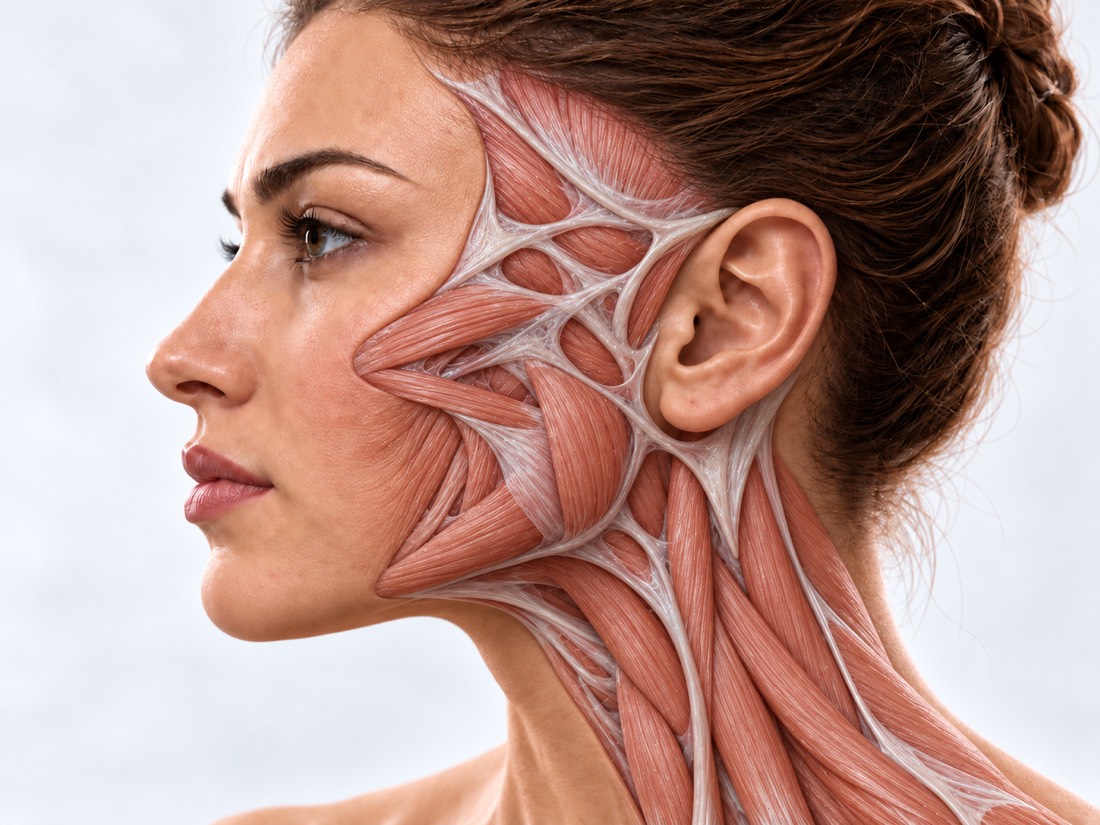 CONCEPTUAL VISUALIZATION
Behind, the lower jaw rises up with two branches. Each ends with a condylar process: its head lies in the joint just in front of the ear. How the jaw moves, how wide the mouth opens and how the teeth converge depends on this process.
Doctors distinguish between three levels of a fracture: the base of the process, its neck, and the head — the part that lies inside the joint. Treatment and risks of surgery depend on the level. The fracture is on one side or both.
How to treat such fractures, surgeons have been arguing for decades. Previously, they mostly did without surgery; research in recent years for some displaced fractures shows the benefits of surgery, but it has its own risks. Fractures of the body and the corner of the jaw, where the teeth stand, are treated differently - a separate page is devoted to them.
This is general information. The doctor will tell you what will suit you after the examination.
The blow could hit the chin, but it hurts near the ear: the force is transmitted through the jaw to the joint.
The area in front of the ear on the side of the fracture hurts and swells, especially when opening the mouth or chewing.
It is not possible to open the mouth wide, and the chin at the same time shifts in the direction of the fracture.
On the side of the fracture, the canines meet earlier. If both processes are broken, the front teeth may not close at all.
After a blow, blood may flow from the ear - this is a sign with which 103 is called.
If the fracture did not fuse properly: the jaw moves limitedly, the joint clicks or hurts, the face becomes asymmetric.
Dysfunction of the jointThe condylar process is more often broken in a fall or in a car accident, and in children such a fracture is easy to miss.
In a 13-year analysis of isolated jaw fractures, falls from a height and traffic accidents were associated with a higher likelihood of fracture of the condyle itself (odds ratio 4.75 and 3.02).
In preschool children, it is easy to miss a fracture of the appendage, so after falling on the chin, the child should be shown to the doctor.
This is the name given to the condition when the joint grows and the mouth stops opening. If a child's fracture is not recognized or treated incorrectly, some children may experience ankylosis, facial deformity, malocclusion, and long-term pain.
Ankylosis of the jointIf persistent pain, ankylosis or bone inflammation remain after treatment, the joint is sometimes replaced with a prosthesis.
Destruction of the joint headA fracture of the appendage occurs after falls and road accidents, and such a blow can damage both the head and the neck. Therefore, a head injury is first ruled out. Do not get behind the wheel. Call 103 if at least one of the following symptoms appears after the impact:
On the same day - to the maxillofacial surgeon or to the reception department: after the blow, it hurts in front of the ear, the mouth does not open as before, the chin shifts to the side, the teeth close differently. A child with such complaints after a fall should also be shown to the doctor on the same day. If a person loses consciousness for a short time after a blow, immediately go to the reception room (let them take you away). On the same day, go to the doctor - and after a blow to the head, if you feel nauseous or have vomited, feel dizzy, are on blood-thinning drugs, or have been drinking. After the operation - immediately to the surgeon who operated, and if it does not work - to the waiting room: increasing pain or swelling in front of the ear or under the jaw. Rapid swelling of the face or neck with difficulty breathing is 103. On the same day, to your surgeon: the temperature has risen, pus or a clear liquid is coming out of the wound, facial expression is weakening on the side of the operation: the eye does not close or the corner of the mouth is lowered. Planned: the fracture has healed, but the mouth opens limitedly, the joint clicks or hurts, the face has become asymmetric. After such a fracture, the child is shown to the doctor again while the jaw is growing.
First, the head, neck and ear: blood in the ear, clear fluid, hearing.
The doctor checks how much the mouth opens, where the chin moves, how the teeth close on both sides.
Shows the level of the fracture—base, neck, or head—how much the fragment is displaced and whether the head is out of joint, as well as a second jaw fracture.
The surgeon considers the level and displacement of the fracture, age, bite and general condition.
Repeated examinations of mouth opening and bite, in children - while the jaw is growing.
There is no single rule. A review of systematic reviews in 2020 suggested that decisions should be made based on whether the fragment can be reliably fixed, the joint and bite restored, and the characteristics of the patient himself.
The fragment is almost not displaced; most children.
Displaced fractures of the base and neck of the process in adults.
Head, children, bilateral fractures.
At Dr. Valikhnovskyi's Institute of Surgery, fractures of the condylar process are dealt with by the "New Face" department - from a fresh fracture to joint restoration. Head trauma is managed by a neurosurgeon, orthodontic treatment of the bite by an orthodontist.
Plastic surgeon, candidate of medical sciences, founder of Dr. Valikhnovskyi Institute of Surgery.
Short answers. What is right for you, the doctor will tell you during the consultation.
No. Non-displaced or slightly displaced fractures and most fractures in children are treated without surgery. For displaced fractures of the base and neck in adults, experts recommend surgery.
There is a risk: the branches of the nerve pass nearby. Temporary facial weakness is more common than permanent and depends on the approach chosen by the surgeon.
A child's appendage is capable of rebuilding itself and regaining its shape, especially at a younger age. But you need to monitor the child: incorrect fusion can limit the opening of the mouth.
Call 103. Blood from the ear after a blow can be a sign of a serious head injury.
The bite may improve over time, but not always completely. In the register of patients with a bilateral fracture, after 3 months, a disturbed bite remained in 18.6%.
If the fracture was not recognized or treated incorrectly, occlusion disorders, limited opening of the mouth and long-term pain are possible, as well as facial deformity or joint ankylosis in children.
The figures on the page are from these sources.
Send CT scans and discharges. The doctor will tell if an operation is necessary or if the fracture can be managed without it.
Leave your contact details and briefly describe the situation. A coordinator will contact you to agree on the next step.