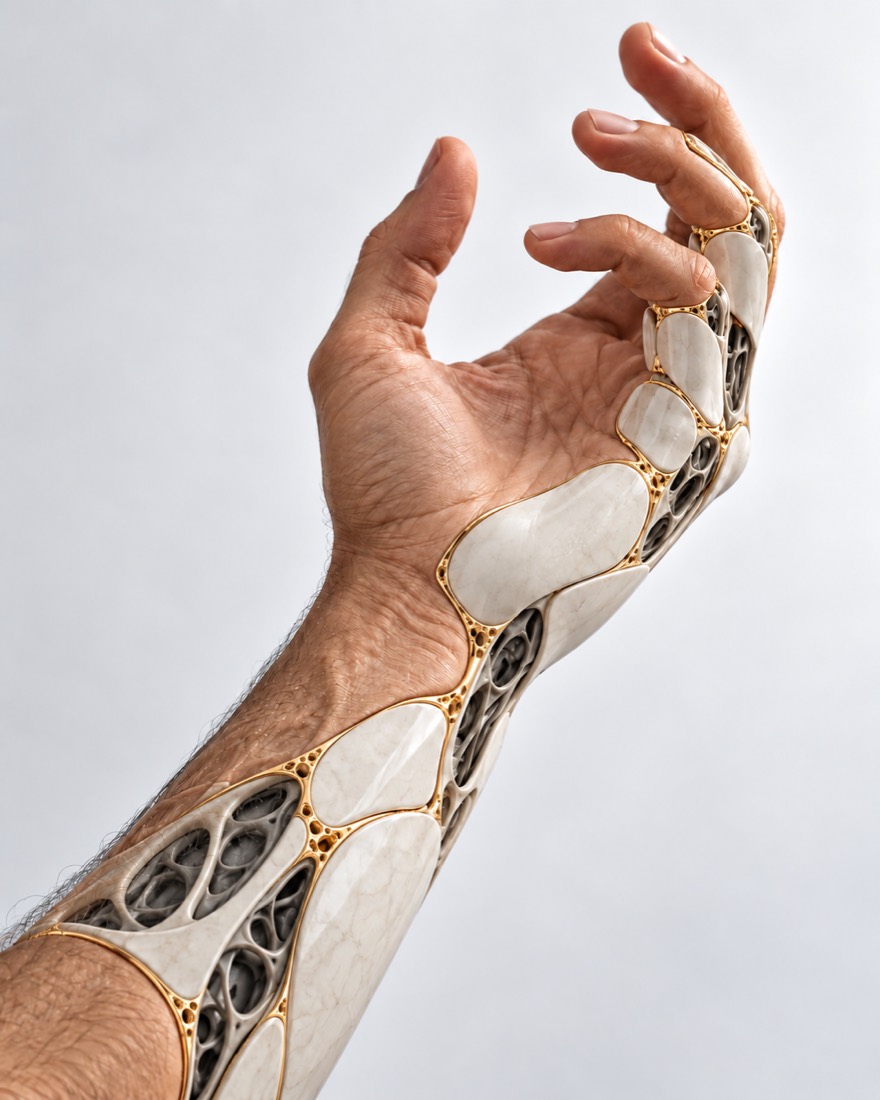
Hand tendon injury — a rupture of the cord that transmits motion from the muscle to the finger. A typical sign is that after a cut, the finger does not bend or straighten; in that case, you need to go to the emergency room immediately. A complete rupture is stitched, and whether movement returns depends on post-suture rehabilitation.
Rupture of the tendon that bends or straightens the finger — due to a cut, wound, or blow.
The main feature
The finger does not fully bend or straighten after a wound or impact.
When to see a doctor
After a cut with this sign — immediately to the emergency room; a closed injury without a wound — the same day.
What the outcome depends on
On a strong suture and hand therapy with a rehabilitator after surgery.
01 / WHAT IS IT
What is tendon injury.
Tendons are strong cords that transmit movement from the forearm muscles to the fingers. Flexor tendons run along the palm and bend the fingers, extensors run along the back of the hand and straighten them.
When a tendon is cut or torn, the muscle contracts, but the finger does not move, and the hand grips worse. A complete rupture is treated surgically — the tendon is stitched.
The most complex area is the flexor tendons between the middle of the finger and its base on the palm, the so-called zone II: it is tight here, and complications after suturing occur more often. Surgeons even call it 'no man's land.'
This is general information. The doctor will tell you what will suit you after the examination.
02 / SIGNS
How tendon injury presents.
The wound can be small, but the tendon underneath it can be cut. Therefore, it is important not only to close the wound but also to check the movement of each finger.
01
The finger does not bend
After a cut on the palm or finger, it is impossible to bend the finger — completely or at one joint.
02
The finger does not straighten
After an injury on the back of the hand, the finger remains bent and cannot be straightened on its own.
03
The tip hangs down
After a blow to the fingertip, it is bent and does not straighten, even without a wound. This is a mallet finger — the extensor at the tip is damaged.
04
Numbness
Numbness on the side of the finger or at the tip near the wound — the nerve may also be damaged.
A cut after which the finger does not bend, does not straighten, or the skin is numb is a reason to immediately go to the emergency department, not wait for the wound to heal. While you are going: press the wound with a clean cloth, raise your hand, remove rings.
103 immediately if:
blood gushes, bright red, it is difficult to stop;
Bleeding does not stop despite a tight bandage.
Do not delay a visit to the doctor:
Immediately - to the reception department: After a cut, the finger does not bend or straighten; numbness near the wound; a deep wound on the palm or finger; a fragment, such as glass, is stuck in the wound — do not remove it yourself. Do not drive — have someone take you or call 103. Immediately - to the surgeon who operated, and if it does not work - to the waiting room: After a stitch, the finger suddenly stopped bending or straightening, pain and swelling are increasing. On the same day: After a hit or jerk without a wound, the finger does not bend or the tip is bent and does not straighten; the wound is red, swollen, increasingly painful, pus is coming out, and a fever has appeared. Planned: If the injury was a long time ago, and the finger still does not move completely, — make an appointment for a consultation.
05 / DIAGNOSTICS
As defined, What is injured.
Conversation
With what and when you were injured, the position of the hand, which hand is dominant, what the work is.
Checking movements
The doctor asks to bend and straighten each joint of each finger separately — this shows which tendon is not working.
Sensitivity and blood circulation
The fingertips’ sensitivity and skin color are checked: along with the tendon, a nerve or vessel may be damaged.
Pictures
X-ray — if there is suspicion of a fracture or fragment in the wound. For the diagnosis of flexor injury, images have a limited role: the main thing is examination.
06 / TREATMENT
How we treat tendon injury.
A complete tendon rupture is stitched. How and when — is decided by the surgeon depending on the location of the rupture, the state of the wound, and the damage to surrounding tissues. After the suture, the result largely depends on the rehabilitation of the hand.
01
Flexor suture
The finger does not bend.
when
As soon as possible, as soon as the wound allows. In a series of 100 sutured tendons, the suture more often came apart if the surgery was delayed for more than 72 hours. At the same time, in a series of 31 fingers sutured on average after 15 days, 87% had a good or excellent outcome — so if a few days have passed, the suture is not abandoned, but neither should one wait.
How
The International Federation of Societies for Surgery of the Hand (IFSSH, 2025) recommends a strong suture and early active movements. According to the 2025 review, in zone II a suture is needed in which at least four threads pass through the rupture site.
Complications
In a meta-analysis of studies after flexor tendon sutures, reoperation was required in 6% of cases, the suture came apart in 4%, adhesions formed in 4%.
Partial injury
Some partial flexor ruptures can be managed without a suture — with equally strict mobilization. Which exact proportion, studies have not determined.
02
Extensor suture
The finger does not straighten.
A complete break
They suture it, then the hand is fixed with a splint. In a review of 19 studies, complications occurred in 4.1% with a static splint, 4.3% with a dynamic splint, and 1.7% with early active movements; function was generally good with all three regimens.
Partial tear
Individual partial tears of the extensors are treated without suturing — with a splint and exercises; the evidence for this is low quality.
Mallet finger
Closed distal injury is treated with a splint for up to 8 weeks; recovery may take several months. Surgery is rarely needed.
03
Rehabilitation after suturing
Exercises with a physiotherapist.
What do you advise?
IFSSH recommends early active finger movements after flexor tendon repair. However, evidence is conflicting, so the protocol is chosen by the surgeon and physiotherapist together.
What is known
A Cochrane review (17 studies, 1108 participants) assessed the evidence for different rehabilitation protocols as very low certainty. A 2019 systematic review found no advantage of active movements but found moderate to high-quality evidence that 'place and hold' exercises yield better outcomes than passive flexion.
Active or passive
In a meta-analysis of 28 studies (1414 patients) after Zone II repair, active movements better restored range of motion, while reoperations and grip strength were comparable.
04
Analgesia
During surgery.
WALANT
Surgery under local anesthesia without a tourniquet, patient awake. In a meta-analysis of 12 randomized studies, pain during surgery was less than with other types of regional anesthesia, and duration was the same.
Or general anesthesia
In a randomized study on 86 fingers, flexor tendon repair in zone II under WALANT did not outperform repair under general anesthesia: 49% and 56% of fingers had good or excellent outcomes, the difference was not significant.
05
Delayed reconstruction
If the suture was not done on time or it failed.
Graft in a single stage
If the ends do not come together, IFSSH recommends tendon grafting in one operation when the finger's annular ligaments are not destroyed.
In two stages
If the connections need to be restored, they are made first, and the graft is placed in the second stage.
Anastomoses
When the sutured tendon has fused with the tissues, it is released surgically — by tenolysis: in a series of 31 fingers, it was needed in 4.
07 / AT THE VALIKHNOVSKYI INSTITUTE
How we treat it.
Tendon injuries of the hand at the Dr. Valikhnovskyi Institute of Surgery are treated in the "Hand and Foot Reconstruction" direction — along with nerve injuries, wounds, and hand scars. If the wound is fresh and bleeding, first — the emergency department: stop the bleeding and close the wound.
Tendon and nerve suture — for a fresh injury, when the ends come together without tension.
Tendon repair with a graft — if the ends do not come together without tension or the injury is old.
Nerve graft with own nerve — if the nerve is injured along with the tendon and its ends do not come together.
Surgery under local anesthesia (WALANT) — without a tourniquet and anesthesia — the patient is awake.
Splints — protect the suture for several weeks after surgery.
Hand rehabilitation — exercises with a rehabilitation therapist are part of treatment: without them, the risk of adhesions and limited movement increases.
Rostislav Valikhnovskyi
Plastic surgeon, candidate of medical sciences, founder of Dr. Valikhnovskyi Institute of Surgery.
Photos and extracts onlineSend a photo of the hand, discharge summaries, and images — the doctor will preliminarily assess the situation.
ConsultationChecking the movement of each finger, sensitivity, and the condition of the wound or scar.
PlanSuture or graft, in one or two stages, what type of anesthesia.
SurgerySuture or tendon repair, if needed — along with the nerve.
DevelopmentSplint for several weeks and exercises with a rehabilitation therapist according to the surgeon's scheme; the protocol is chosen by the surgeon and rehabilitation therapist together.
Short answers. What is right for you, the doctor will tell you during the consultation.
How to understand that the tendon is injured?
After a cut, the finger does not bend or straighten completely — even if the wound is small. With this sign, one must go immediately to the emergency department.
Is it possible not to sew the tendon?
A complete rupture is treated with surgery — the tendons are sewn. Certain partial ruptures are treated without sutures — with a splint and exercises, but the decision is made by the surgeon after examination.
How long can I wait for surgery?
Do not delay: in a small series, the suture more often came apart if the surgery was delayed more than 72 hours. If a few days or weeks have passed, the tendon can still be sutured or restored with a graft.
How long should a splint be worn?
Usually a few weeks, and exercises start earlier according to the surgeon's plan. Which splints and how long to wear them have not been compared in randomized studies.
Can the suture come apart?
Yes. In a meta-analysis, after flexor tendon suturing, the suture came apart in 4% of cases, and reoperation was needed in 6%. If a finger suddenly stops moving — immediately go to the surgeon.
Will the finger move as before?
Depends on the location of the rupture, the suture, and rehabilitation. In a randomized study of Zone II sutures, good or excellent results after 6 months were achieved in 49–56% of fingers; some patients require tenolysis due to adhesions.
Is it possible to operate without anesthesia?
Yes, it is possible — under local anesthesia without a tourniquet (WALANT). The choice between it and general anesthesia is made together with the surgeon.
09 / SOURCES
Sources
16 sources · IFSSH consensus, Cochrane, systematic reviews, and NHSshowCollapse
The IFSSH consensus and current guidelines on flexor tendon repairs and reconstructionJournal of Hand Surgery (European Volume), 2026doi:10.1177/17531934251404821 ↗
Rehabilitation following surgery for flexor tendon injuries of the handCochrane Database of Systematic Reviews, 2021doi:10.1002/14651858.CD012479.pub2 ↗
Flexor tendon rehabilitation in the 21st century: A systematic reviewJournal of Hand Therapy, 2019doi:10.1016/j.jht.2018.06.001 ↗
Maximizing hand function following zone II flexor tendon repair: A systematic review and meta-analysis of rehabilitation strategiesJournal of Hand and Microsurgery, 2024doi:10.1016/j.jham.2024.100152 ↗
Complications After Flexor Tendon Repair: A Systematic Review and Meta-AnalysisThe Journal of Hand Surgery, 2012doi:10.1016/j.jhsa.2011.11.006 ↗
Flexor tendon repair in zone II of the hand: Evidence-based managementHand Surgery and Rehabilitation, 2025doi:10.1016/j.hansur.2025.102230 ↗
Rupture rate following primary flexor tendon repair of the hand with potential contributing risk factorsSurgical Technology International, 2014pubmed.ncbi.nlm.nih.gov/24526425 ↗
Up to five-week delay in primary repair of Zone 2 flexor tendon injuries: outcomes and complicationsJournal of Hand Surgery (European Volume), 2021doi:10.1177/17531934211024435 ↗
Effect of Aftercare Regimen With Extensor Tendon Repair: A Systematic Review of the LiteratureJournal of Surgical Orthopaedic Advances, 2012doi:10.3113/jsoa.2012.0246 ↗
The management of partial extensor tendon lacerations of the hand and forearm: A systematic reviewJournal of Plastic, Reconstructive & Aesthetic Surgery, 2023doi:10.1016/j.bjps.2023.06.004 ↗
Outcomes of Zone II Flexor Tendon Repair Under General Versus Wide Awake Local Anesthesia: A Randomized Controlled TrialThe Journal of Hand Surgery, 2024doi:10.1016/j.jhsa.2024.06.008 ↗
Wide-Awake Local Anesthesia No Tourniquet in hand surgery: A systematic review and meta-analysisHand Surgery and Rehabilitation, 2024doi:10.1016/j.hansur.2024.101778 ↗
 Discuss your case
 CONCEPTUAL VISUALIZATION