CONDITION / ARMS AND LEGS

Post-traumatic contracture.

Post-traumatic contracture is a persistent limitation of joint movement after an injury or surgery: a finger, hand, or elbow cannot fully extend or bend. Treatment begins with splints and exercises, and surgery is considered if these do not help.

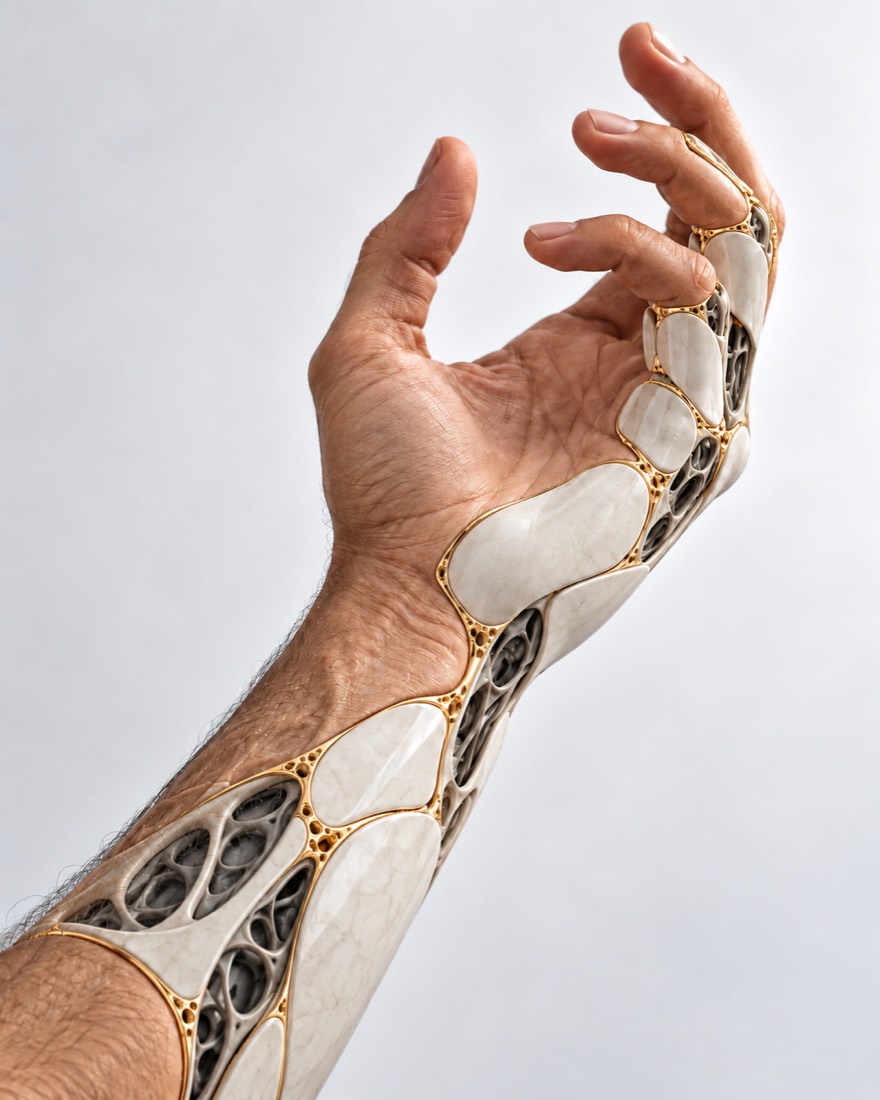
Conceptual visualization: restoring movement in hand jointsCONCEPTUAL VISUALIZATION
What it is
The joint does not fully extend or bend after an injury because the tissues in it or around it have tightened.
Where more often
The middle joint of the finger and the elbow are prone to stiffness after injuries.
The first step
Splints, staged casts, and exercises; surgery is considered if they do not help.
Expectations
Surgery can significantly increase the range of motion, but it does not always fully restore it to pre-injury levels.

What is
Post-traumatic contracture.

For the joint to move, an intact bone and smooth joint surfaces, freely sliding tendons, elastic ligaments, capsule, and skin are needed. After an injury, any of these tissues may scar or shorten — and the joint becomes fixed in a bent or extended position. Doctors call this a contracture.

The middle joint of the finger — due to its complex structure — and the elbow are prone to stiffness: after elbow injuries, it occurs relatively often. Because of a stiff finger, the hand grips objects worse, and because of an elbow that does not straighten, it is harder to reach the face or get dressed.

At an early stage, splints and exercises may help, while long-standing contractures often require surgery. Contractures after burns have their own characteristics — there is a separate page about them.

This is general information. The doctor will tell you what will suit you after the examination.

How
contracture presents.

Movement limitations are noticed after an injury, removal of a cast, or surgery. Typical complaints:

01

The finger does not straighten

The finger remains bent, unable to place the palm flat on the table.

02

The finger does not bend

Unable to make a fist, touch the palm with the fingertip, or hold a small object.

03

Wrist or elbow

The arm does not straighten at the elbow or the palm does not turn upward; the wrist moves only slightly.

04

The scar tightens

After the wound, the scar passes through the joint and pulls it into a bent position.

Post-burn contracture
05

Pain and swelling

The joint hurts when trying to mobilize it, swells after load.

06

Weak grip

The hand tires quickly, it is difficult to work with a tool, write, hold a cup.

Why joint
freezes.

Movement may be limited by one tissue or several at the same time — treatment depends on this. Typical causes:

Joint injury

A fracture or dislocation affecting the joint damages joint surfaces, ligaments and capsule — they scar.

The tendon has healed with scars

After injury or suture, adhesions may form between the tendon and its sheath — the tendon stops sliding.

Hand tendon injury

The bone has healed incorrectly

Displacement of fragments changes the axis of the finger or hand, and the joint cannot move fully.

Bone defect after injury

Skin scars

After wounds, injuries, and burns, a scar across the joint tightens it.

Soft tissue defect

Extra bone in the tissues

Around the elbow after injury, bone tissue can form where it shouldn’t be — this is one of the two main causes of elbow stiffness.

Ischemic contracture

After compartment syndrome — high pressure in the forearm muscles — the muscles die and scar. Most often this is related to trauma.

When to seek medical advice?

A contracture that develops over weeks or months usually does not require urgent care: it is a planned consultation. But sudden severe pain after an injury or surgery, especially under a cast or tight bandage, may indicate compartment syndrome — in that case, surgery is needed as soon as possible.

103 or immediately to the reception department, if:

  • sudden severe pain in the hand or foot after a recent injury or surgery;
  • under a cast, splint, or tight bandage, the pain becomes increasingly stronger and intensifies when you try to move your fingers.

Do not delay a visit to the doctor:

Immediately — to the surgeon who operated, and if that is not possible, — to the emergency department: after surgery on the hand or joint, the pain or swelling gradually increases, but there are no signs for 103. On the same day: after an injury, the finger does not move, has changed shape or color, part of the hand has lost sensation; the wound is red, swollen, increasingly painful, has pus, or there is a fever. In the coming weeks: after removing a cast or splint, the joint does not extend or bend, and exercises do not improve it, — at the early stage, a splint and exercises may help. Planned: long-standing contracture that interferes with work or self-care.

As defined,
that holds the joint.

  1. Conversation

    What kind of injury it was, if there were surgeries, how long the cast lasted, what rehabilitation has already been done, and what has changed.

  2. Movement Measurement

    The doctor measures the angles to which the joint bends and straightens on its own and with assistance — this shows where the limitation is.

  3. What exactly is restricting

    Skin and scar, tendons, or joint capsule — this determines what needs to be released.

  4. Pictures

    X-rays or CT scans show bone fusion, the condition of joint surfaces, and excess bone tissue.

  5. Nerves and blood vessels

    Finger sensitivity and blood supply — they affect the choice of surgery.

How we treat
Post-traumatic contracture.

Treatment progresses from simple to complex: first splints and exercises, then surgery on the tissue that limits movement.

01

Without surgery

The first step for most contractures.

Finger splints
Splints or staged casts are tried before surgery. In a review of 12 studies on post-traumatic contracture of the middle finger joint, a splint along with rehabilitation improved extension by 16.7° more than rehabilitation alone.
Elbow splints
Splints that gradually extend the elbow, in a review of 8 studies (232 patients), increased the range of motion on average by 36° or 37°, depending on the type of splint. The authors recommend continuing for up to 12 months or until movement improves.
Exercises
In a review of 59 occupational therapy articles, the strongest evidence supports early active movement after surgery and splints. In contrast, stretching lasting up to 7 months, according to a Cochrane review (49 studies, people with various conditions), did not clinically significantly increase joint movement, so the program is tailored to the specific joint and cause.
02

Operations

If splints and exercises did not help.

Tenolysis
Tendons are freed from adhesions. In a review of 5 studies of limited quality (103 fingers), a good or excellent result was observed in 78.9%, complications occurred in 15.3%.
Release of the joint
The capsule and ligaments are incised step by step, checking movement after each step. For the finger's middle joint, most series report an improvement in extension of 25–30°.
Skin and scars
Scar tissue is incised or excised, and skin defects are closed with a Z-plasty, graft, or flap.
Bone
A malunited bone is cut and placed in the correct position — this is an osteotomy.
Elbow
Elbow release, either open or through punctures (arthroscopically), according to a review of 99 studies, improved movement and reduced pain; the method is chosen based on joint condition and surgeon experience.
03

Severe cases and recovery

What to expect.

Joint fixation
If the finger is very bent or its blood supply is impaired, instead of mobilizing it, the joint may be fixed in a comfortable position.
After surgery
Frequent sessions with a rehabilitation therapist and splints are needed — the outcome largely depends on them.
The result
Surgery can significantly increase movement, but full recovery, as before the injury, is not always achieved — rarely for the elbow; complications occur frequently.

How
we treat it.

Post-traumatic contractures of the hand and fingers at the Valikhnovskyii Institute of Surgery are treated in the 'Hand and Foot Restoration' department. Initially — splints and rehabilitation; surgery is offered if movement is restricted by scars, lack of skin, or improperly healed bone.

CLINIC SERVICE Hand and foot rehabilitation Grasping, sensitivity, support, and movement after injuries, wounds, and burns: fingers, tendons, nerves, and bones. View service

What we do for this condition

  • Dissection of scar tissue and Z-plasty — scar contractures of the fingers and small skin defects.
  • Skin graft or local flap — when there is not enough skin after joint release; for a large defect — microsurgical flaps.
  • Osteotomy — the bone is cut and placed in the correct position according to the virtual plan, fixed with plates.
  • Splints — after surgery, the hand is immobilized so that the skin and tissues do not tighten again.
  • Hand rehabilitation — exercises with a rehabilitation specialist are part of the treatment, not an addition.

Rostislav Valikhnovskyi

Plastic surgeon, candidate of medical sciences, founder of Dr. Valikhnovskyi Institute of Surgery.

How treatment works with us

  1. Photos and videos onlineSend a photo of the hand and a video showing how you bend and straighten the fingers, as well as X-rays and discharge summaries.
  2. ConsultationMeasurements of movements, review of scars, assessment of X-rays and what has already been done.
  3. PlanWhether splints and exercises are enough, or if surgery is needed — and on which tissue.
  4. TreatmentSplints and rehabilitation or surgery; if necessary — several stages.
  5. RecoverySplints and sessions with a rehabilitation specialist; the doctor will explain the schedule of check-ups.

Common
questions

Short answers. What is right for you, the doctor will tell you during the consultation.

Is it possible to work out the joint without surgery?

It happens, especially at an early stage: with prolonged and regular use of splints, a good result can be achieved. For fingers and the elbow, splints are used that gradually extend the joint.

How long should a splint be worn?

For a long time: weeks and months. For the elbow, the authors of the review recommend continuing up to 12 months or until movement improves. The schedule is determined by a doctor and a rehabilitation specialist.

When is surgery necessary?

When splints and exercises did not help, and the limitation interferes with work or self-care. For long-standing contractures, surgery is often needed.

Will full movement return?

Not always. Surgery can significantly increase the range of motion, but restoring movement completely, as it was before the injury, is not possible for everyone, and for the elbow — rarely.

What is tenolysis?

An operation during which the tendons are freed from adhesions so that it can glide again. In a review of 103 fingers, good or excellent results were observed in 78.9%, complications in 15.3%.

How is this different from post-burn contracture?

After a burn, movement is limited by skin scars, whereas after an injury — also by the joint, tendon, or bone, so the treatment plan is different. Post-burn contractures are on a separate page.

What should be done after surgery?

Wear the splint according to the scheme and work frequently with a rehabilitation specialist — much of the outcome depends on this.

Sources

16 sources · systematic reviews, meta-analyses, reviews, and NHS
showCollapse
  1. Stretch for the treatment and prevention of contracturesCochrane Database of Systematic Reviews, 2017doi:10.1002/14651858.CD007455.pub3 ↗
  2. Orthotic interventions for restoring proximal interphalangeal joint motion for patients with hand injuries or conditions: A systematic review and meta-analysisJournal of Hand Therapy, 2024doi:10.1016/j.jht.2023.12.018 ↗
  3. Outcomes of Isolated Digital Flexor Tenolysis: A Systematic ReviewThe Journal of Hand Surgery (Asian-Pacific Volume), 2021doi:10.1142/S2424835521500557 ↗
  4. Posttraumatic proximal interphalangeal joint flexion contracturesJournal of the American Academy of Orthopaedic Surgeons, 2006doi:10.5435/00124635-200609000-00002 ↗
  5. Treatment of Proximal Interphalangeal Joint ContractureHand Clinics, 2018doi:10.1016/j.hcl.2017.12.012 ↗
  6. The stiff proximal interphalangeal joint – an unsolved problem?Journal of Hand Surgery (European Volume), 2023doi:10.1177/17531934221143690 ↗
  7. Rehabilitation for distal radial fractures in adultsCochrane Database of Systematic Reviews, 2015doi:10.1002/14651858.CD003324.pub3 ↗
  8. Effectiveness of Occupational Therapy Interventions for Adults With Musculoskeletal Conditions of the Forearm, Wrist, and Hand: A Systematic ReviewAmerican Journal of Occupational Therapy, 2017doi:10.5014/ajot.2017.023234 ↗
  9. Post-traumatic stiff elbowEFORT Open Reviews, 2018doi:10.1302/2058-5241.3.170062 ↗
  10. Surgical treatments of post-traumatic elbow stiffness: a systematic review and meta-analysisJournal of Shoulder and Elbow Surgery, 2026doi:10.1016/j.jse.2025.05.004 ↗
  11. Static progressive versus dynamic splinting for posttraumatic elbow stiffness: a systematic review of 232 patientsArchives of Orthopaedic and Trauma Surgery, 2015doi:10.1007/s00402-015-2199-5 ↗
  12. Posttraumatic elbow stiffnessThe Journal of Bone and Joint Surgery, 2012doi:10.2106/JBJS.K.00711 ↗
  13. Refinements in the Treatment of Volkmann Ischemic Contracture of the Forearm: A Thematic ReviewPlastic and Reconstructive Surgery – Global Open, 2024doi:10.1097/GOX.0000000000005532 ↗
  14. Compartment syndromeNHS, 2026nhs.uk/conditions/compartment-syndrome ↗
  15. Finger painNHS, 2025nhs.uk/symptoms/hand-pain/finger-pain ↗
  16. Cuts and grazesNHS, 2026nhs.uk/conditions/cuts-and-grazes ↗

The figures on the page are from these sources.

VALIKHNOVSKI SURGERY PARTNERS

The joint does not extend
after an injury?

Send a photo and a short video of hand movements. The doctor will say whether splints and exercises are enough or if surgery is needed.

Call Send an enquiry
ONLINE ENQUIRY

Tell us how we can help.

Leave your contact details and briefly describe the situation. A coordinator will contact you to agree on the next step.

Preferred contact method