Wide scar
The stitch has come apart or the scar gradually stretched into a wide stripe visible from afar.
 Discuss your case
Forehead scar deformation is a scar from injury, surgery, or burn that has widened, pulled the skin, or displaced the eyebrow or hairline. It is corrected gradually: care and laser treatment, and if necessary — surgery.
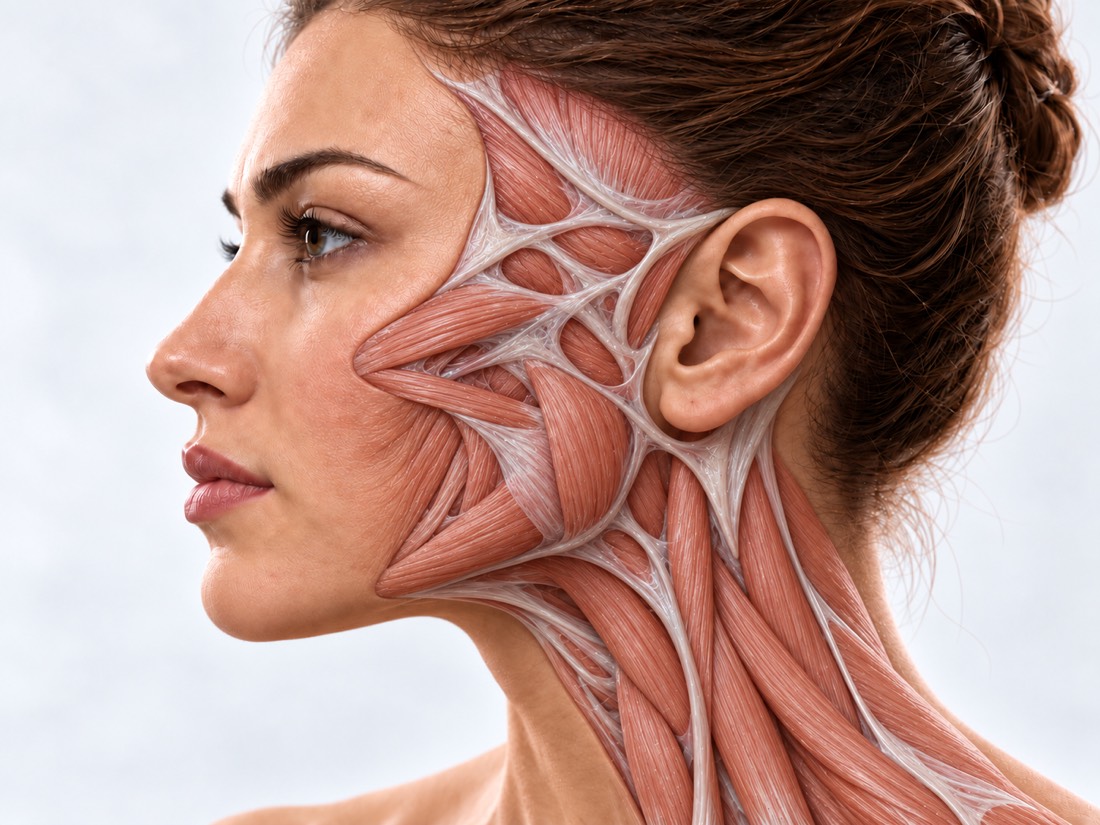 CONCEPTUAL VISUALIZATION
The forehead is a large exposed area of the face that cannot be hidden under clothing. The skin here is not very elastic: a wide wound is difficult to close without tension, and tension makes the scar wider. Therefore, surgeons consider the treatment of forehead wounds and scars a separate task with its own specific features.
Deformation is discussed when a scar is not just visible but changes the appearance of the forehead: it stretches into a wide strip, sinks and forms a step, pulls the eyebrow up or down, shifts the hairline, or looks like a patch of a different color after a skin graft.
Natural landmarks are important for the forehead — the eyebrows, the hairline at the forehead and temples, and horizontal folds. During correction, the surgeon tries to maintain the symmetry of the eyebrows and hide the scar along these lines. Additionally, nerves and blood vessels run under the forehead's skin, which must be preserved during surgery.
This page is specifically about the forehead. There is a separate page, "Facial Scar Deformation," about scars that change the shape of other parts of the face.
This is general information. The doctor will tell you what will suit you after the examination.
Signs depend on the exact location of the scar and how much tissue has been lost. Often, not only the scar itself is concerning, but also that the forehead and eyebrows have become asymmetrical.
The stitch has come apart or the scar gradually stretched into a wide stripe visible from afar.
At the scar site, the skin is pulled in, a step or pit has appeared, especially noticeable in side lighting.
The scar pulls the eyebrow up or down, and the face looks asymmetrical — even at rest.
A scar near the forehead or temple has shifted the hairline, and there is a nearby area without hair.
After a skin graft or healing of a wound without suturing, the area differs in color and texture from the rest of the forehead.
The scar is raised, firm, red, or itchy. If it extends beyond the wound, it may be a keloid.
Keloid scars on the faceThe cause determines how much skin is lost and whether the neighboring forehead skin is sufficient to correct the scar.
Hits, falls, car accidents. A torn wound on the forehead can heal with a wide or depressed scar.
Scars after injuries and cutsThe forehead and temple are common sites for skin cancer. After tumor removal, a wound remains, which is closed with a suture, flap, or skin graft.
Basal cell carcinoma of the faceWhen the nose is reconstructed using a flap from the forehead, the wound on the forehead is sutured. Tension can make the scar wider or cause the suture to separate.
Nose defects after removal of tumorsSevere burns on the forehead are rare; scars may also affect adjacent areas of the face.
Scars after facial burnsIf the bone under the scar is damaged, it is first assessed, and then the skin.
Fractures of the frontal boneAn old scar on the forehead does not require emergency care: it is treated electively. But a fresh forehead injury is also a head impact, so first we think about the head, and then about the scar.
On the same day: after a head injury there was vomiting or dizziness; you are taking blood-thinning medications and hit your head; you hit your head after alcohol or other substances; soil or dirt is in the wound and cannot be washed out; you were bitten by a person or an animal; the wound or scar is swollen, painful, warm to the touch, or has pus. Planned: The scar is wide, depressed, has shifted the eyebrow or hairline, is painful, or simply bothers you — schedule a consultation.
When and due to what the scar appeared, how the wound healed, what surgeries have already been done; photos before the injury, if available.
Width and depth of the scar, whether it is still maturing, the position of the eyebrows and hairline, how the eyebrows move, whether there is enough skin nearby.
Straight-on, from the side, with raised eyebrows — for planning and to compare changes over time.
CT scan — if the frontal bone could have been injured under the scar.
It is impossible to completely remove a scar. The goal is to make it narrower, more even, and less noticeable, and to restore the eyebrow to its place. Methods are chosen gradually, from simpler to more complex, considering the size, shape, and location of the scar.
While the scar matures, and together with the operation.
When the scar is wide, retracted, or displaces the eyebrow.
Forehead scars at the Institute of Surgery of Dr. Valikhnovskyi are treated in the 'New Face' program. Laser, IPL, and scar care while it matures — at the clinic, together with a dermatologist.
Plastic surgeon, candidate of medical sciences, founder of Dr. Valikhnovskyi Institute of Surgery.
Short answers. What is right for you, the doctor will tell you during the consultation.
No, any treatment leaves a scar. The goal is for it to become narrower, smoother, and less noticeable, and for the eyebrows to be symmetrical.
Usually after maturation: most scars lighten by 2 years or longer. While the scar is maturing, silicone, sun protection, and laser therapy help.
The surgeon tries to hide it in the horizontal folds, along the eyebrow edge or the hairline. How well this can be done depends on the location and size of the scar.
Laser is one of the main methods for scars after injuries. But if the scar is wide, depressed, or pulls the eyebrow, surgery is usually required, and laser is combined with it.
Yes, such a scar is evaluated and treated the same way as other forehead scars: excision, flaps, laser. What will suit you best is determined by the doctor after the examination.
Botulinum toxin in a fresh wound has been shown in studies to improve facial scars, more noticeably on the forehead. But there are still few studies, and whether it is appropriate for you is decided by the doctor.
Eyebrow symmetry is taken into account when planning scar correction. The doctor will tell you exactly how to restore it after an examination.
The figures on the page are from these sources.
Send photos of the forehead straight on, from the side, and with raised eyebrows. The doctor will say what can be corrected and where to start.
Leave your contact details and briefly describe the situation. A coordinator will contact you to agree on the next step.