CONDITION / SKIN AND SCARS

Scars after operations on the face and neck.

Scars after surgeries on the face and neck remain after any incision — on the thyroid gland, after removal of a skin tumor, facelift, or eyelid surgery. Most fade over time, and a noticeable scar can be made less noticeable.

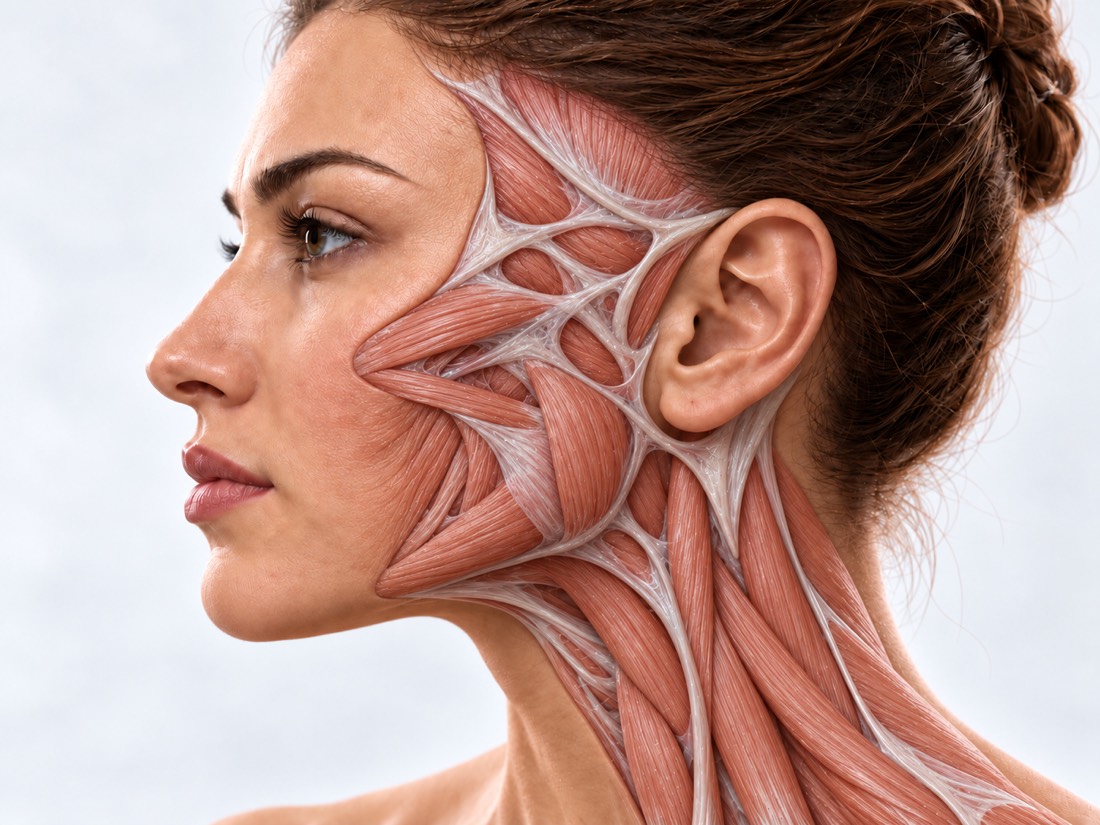
Conceptual visualization: facial and neck skin after healing of a surgical scarCONCEPTUAL VISUALIZATION
What it is
A mark from a surgical incision on the face or neck that has remained noticeable, thick, wide, or tightens the skin.
Why does it appear?
Surgeries on the thyroid gland, removal of skin tumors, facelift, eyelid surgeries, tracheostomy.
When to act
Care — immediately after healing, laser — can be done in the first month; surgical correction — after the scar has matured.
Who treats it
Plastic surgeon and dermatologist — even if you were operated on at another clinic.

What happens
with the scar after surgery.

Any skin incision heals with a scar. The surgeon plans the incision to make it as inconspicuous as possible: in folds, along the hairline, near the ear. But exactly how the scar heals depends on both the individual and the care during the first months.

A fresh scar is initially red, firm, and may pull — after eyelid surgery, for example, it can be noticeable and tight for several months. Most scars gradually lighten and soften, but this takes up to 2 years or more, and the scar never fully disappears.

A scar becomes a problem when it thickens, widens, adheres to the underlying tissues, or displaces nearby landmarks — the hairline, earlobe, or eyelid edge. Scars on the face and neck can be distressing: reviews on scars after thyroid surgery emphasize that a thick scar on the neck can significantly affect psychological well-being and quality of life.

This page is about scars specifically after surgeries: what can be done immediately after healing and how to correct a scar that has already formed.

This is general information. The doctor will tell you what will suit you after the examination.

When to show a scar to a doctor
It is worth showing a scar to a doctor.

Redness and slight tightness in the first months are a normal part of healing. It is worth seeing a doctor if the scar changes in an unexpected way or causes discomfort.

01

Thickens and rises

The scar has become higher, firm, red, itchy, but remains within the suture line.

Hypertrophic facial scars

02

Extends beyond the suture

The scar grows wider than the incision and does not decrease by itself — this is how a keloid behaves.

Keloid scars on the face
03

Expanded

A thin suture has gradually stretched into a wide strip.

04

Tightens when swallowing

A scar on the neck is pulled in and moves up and down when a person swallows. This happens after a tracheostomy: the scar sticks to the trachea, causing discomfort and pain.

05

Landmarks have shifted

After a facelift, the hairline or sideburns have risen, earlobes are at different heights, hair near the scar has thinned.

Complications after a facelift

After which surgeries
visible scars remain.

A scar can become noticeable after any surgery. It depends on the surgery where it is and what can be done with it.

Thyroid gland

Open surgery usually leaves a wound on the neck about 4–6 cm long. In a retrospective study of 4,238 patients after such surgery, a thick scar was associated with younger age, higher body mass index, prominent neck muscles, previous keloids, and the scar being within 1 cm of the suprasternal notch.

Facelift

The incisions run from the temple above the hairline, in front of the ear, under the earlobe, and behind the ear. The scars should lighten, but sometimes they become thick and noticeable.

Complications after a facelift

Eyelid operations

Scars on the eyelids usually become barely noticeable over time, but sometimes remain visible, and occasionally the eyelid separates from the eye.

Unsatisfactory result of blepharoplasty

Tracheostomy

A scar after tracheostomy is mostly retracted and adheres to the trachea.

When to seek medical advice?

A formed scar does not require emergency care: it is treated on a planned basis. However, in the first days and weeks after surgery, some signs require immediate help.

103 immediately if:

  • bleeding from a wound that does not stop;
  • blood beats in a stream;
  • it is very difficult to breathe - a person suffocates or cannot utter words;
  • after surgery on the neck or face, swelling increases rapidly and it becomes difficult to breathe or swallow;
  • after surgery on the eyelids or near the eye — severe or increasing pain in the eye or around it;
  • the eye bulges or the eyelids do not open;
  • vision worsens or new double vision appears;
  • breathing is very frequent;
  • confusion, slurred speech;
  • skin or lips are pale, bluish, or blotchy;
  • a rash that does not blanch when pressed.

Do not delay a visit to the doctor:

Immediately - to the surgeon who operated, and if it does not work - to the waiting room: severe pain or other unexpected symptoms after surgery on the face or neck (except signs near the eye — for those, call 103). On the same day: the suture or scar is swollen, red, increasingly painful, warm to the touch or oozing pus; fever has developed or you generally feel unwell. Planned: the scar thickens, widens, pulls, moves when swallowing, has shifted the hairline or earlobe, or simply bothers you — schedule a consultation.

As defined,
what to do with the scar.

  1. Conversation

    What was the operation and when, how the scar healed, were there previous keloids or thick scars, what has already been tried.

  2. Review

    Color, height, width, and density of the scar, whether it is still maturing, whether it pulls the eyelid, earlobe, or neck skin, whether it moves when swallowing.

  3. Photo

    In standard angles — to compare changes between examinations.

  4. Surgical documents

    A discharge summary or operation description helps to understand what was done under the scar, especially after tumor removal.

How we treat
Scars after operations.

A scar can be improved, but not erased: it is important to have realistic expectations. The goal is to replace a noticeable scar with a less noticeable one. Simpler methods are tried first, and surgery is reserved for persistent scars.

01

First weeks and months

While the scar is fresh, it can be protected from thickening.

Less tension
International guidelines recommend reducing skin tension, taping the incision, moisturizing, and protecting the fresh scar from ultraviolet light before, during, and immediately after surgery.
Silicone
Guidelines call silicone gel or sheets the first choice. In a meta-analysis of 6 randomized studies (375 patients), post-operative gel reduced scar pigmentation, height, and density; gel and sheets worked comparably.
Early laser
In a meta-analysis of randomized studies, laser therapy started in the first month after surgery helped make the scar less noticeable. In another meta-analysis (14 studies, 492 participants or scars), fractional CO2 laser initiated in the first month gave better results than no treatment or treatment starting after 3 months; most studies included 2–3 sessions or more.
Botulinum toxin
In a meta-analysis of 10 randomized studies (114 cases), botulinum toxin injections after facial surgery resulted in narrower scars with better evaluation scores, while the complication rate did not differ significantly. Whether this is suitable for you should be decided by a doctor.
Sun and massage
Keep the scar protected from the sun for at least a year, apply SPF 30 or higher. Massage can only be done on a fully healed scar.
02

When the scar is already formed

If it remains thick, wide, or pulls on the skin.

Injections into the scar
Depending on the type of scar, the doctor may prescribe steroid injections.
Laser and light
Fractional laser—for texture and density, IPL—for redness and pigmentation.
Excision
The scar is excised and sutured anew with less tension.
Z-, W-plasty and broken line
Techniques that change the direction and shape of the scar. Each has its own indications and limitations.
Scar after tracheostomy
The scar is completely excised along with the altered tissues beneath it, and the neck is reconstructed in layers to prevent the skin from adhering to the trachea.
03

Terms and Phrases

Wait for Maturation
Surgery for resistant scars is done at a later stage and combined with other methods — silicone, laser, injections.
Neck after thyroid gland
According to the review, combining methods works better than each one individually. In a network meta-analysis of 6 studies (408 participants), laser together with steroid and the laser and light methods alone had favorable results, but the evidence is low, and it is too early to make final conclusions.
mood
If a scar is distressing, talking to a psychotherapist can help — tell your doctor about this.

How
we treat it.

Scars after facial and neck surgeries at the Doctor Valikhnovskyi Institute of Surgery are corrected in the direction of a “New Face.” Care for a fresh scar, laser, and IPL — within the scope of rehabilitation after surgeries, wherever you were operated.

CLINIC SERVICE A new face Form, symmetry, facial expressions and functions after injuries, wounds, burns, removal of tumors and congenital changes. View service

What we do for this condition

  • Dermatologist Examination and Care Selection — silicone gel or sheets or tape on the healed scar, explanation of how to use them.
  • Early fractional CO2 laser — often already in the first month, if the scar is at risk of becoming noticeable; and later — for texture and density.
  • IPL — for redness and pigmentation of the scar; the program is selected according to skin type.
  • Control of the ripening of the scar — at follow-up examinations the doctor monitors the scar and promptly suggests treatment if it starts to thicken or darken.
  • Scar excision — the scar is excised and covered with local tissues; for keloids after excision — injections into the scar.
  • Flaps of adjacent zones — when there is not enough skin after excision — nasolabial, cervicofacial, or forehead flaps.
  • Lipofilling — microfat and nanofat under the scar — an auxiliary method for volume and tissue softness.

Rostislav Valikhnovskyi

Plastic surgeon, candidate of medical sciences, founder of Dr. Valikhnovskyi Institute of Surgery.

How treatment works with us

  1. Photo onlineSend a photo of the scar from the front and the side; for the neck — also while swallowing.
  2. ConsultationExamination of the scar, questioning about the surgery and healing, assessment of whether it is still maturing.
  3. PlanWhat to do now — care, laser, injections — and whether surgery will be needed later.
  4. TreatmentLaser, IPL, injections, excision, or flaps — separately or combined.
  5. RecoverySilicone, sun protection, and follow-up check-ups; the final appearance of the scar is assessed after months.

Common
questions

Short answers. What is right for you, the doctor will tell you during the consultation.

Will the scar completely disappear after surgery?

No. Most scars lighten and soften, but this can take up to 2 years or longer, and a trace always remains. Treatment makes the scar less noticeable.

When can laser be started?

Often already in the first month after surgery: in meta-analyses, early laser helped make the scar less noticeable. The exact timing is determined by the doctor after examining the suture.

Does silicone gel really help?

Yes, in randomized studies, gel after surgery reduced the pigmentation, height, and density of the scar. It is applied only to healed skin.

I had surgery at another clinic. Can I come to you?

Yes. Scar care, laser, and IPL are performed after surgeries, no matter where you were operated on, and a noticeable scar can also be corrected surgically.

The scar on the neck after thyroid surgery has thickened. What should I do?

Show it to a doctor: while the scar is maturing, silicone, laser, or injections are used, often in combination. Surgery is considered if the scar remains thick.

When can a scar be corrected with surgery?

Usually after it has matured, when it is clear what it looks like. Excision is combined with silicone, laser, or injections.

A fresh stitch has become red and painful. Is this normal?

If the stitch is swollen, red, increasingly painful, warm to the touch, or oozing pus — see a doctor the same day. Severe pain after surgery is a reason to immediately contact the surgeon, and pain in the eye after surgery near the eye is a reason to call 103.

Sources

17 sources · international guidelines, meta-analyses, reviews, and NHS
showCollapse
  1. Updated scar management practical guidelines: non-invasive and invasive measuresJournal of Plastic, Reconstructive & Aesthetic Surgery, 2014doi:10.1016/j.bjps.2014.04.011 ↗
  2. Efficacy of topical silicone gel in scar management: A systematic review and meta-analysis of randomised controlled trialsInternational Wound Journal, 2020doi:10.1111/iwj.13337 ↗
  3. Effectiveness of Early Laser Treatment in Surgical Scar Minimization: A Systematic Review and Meta-analysisDermatologic Surgery, 2020doi:10.1097/DSS.0000000000001887 ↗
  4. Fractional CO2 Laser to Treat Surgical Scars: A System Review and Meta-Analysis on Optimal TimingJournal of Cosmetic Dermatology, 2025doi:10.1111/jocd.16708 ↗
  5. A Systematic Review And Meta-Analysis: Botulinum Toxin A Effect on Postoperative Facial Scar PreventionAesthetic Plastic Surgery, 2022doi:10.1007/s00266-021-02596-7 ↗
  6. Risk Factors for Scar Formation After Thyroidectomy and Advances in its Prevention and TreatmentAesthetic Plastic Surgery, 2025doi:10.1007/s00266-025-04883-z ↗
  7. Analysis of Risk Factors to Predict Occurrence and Prognosis of Postsurgical Hypertrophic Scar Development: A Review of 4238 CasesYonsei Medical Journal, 2023doi:10.3349/ymj.2023.0003 ↗
  8. Early scar-directed interventions for thyroidectomy scars: a systematic review and network meta-analysisFrontiers in Surgery, 2026doi:10.3389/fsurg.2026.1914326 ↗
  9. Scar Revision and Recontouring Post-Mohs SurgeryFacial Plastic Surgery Clinics of North America, 2017doi:10.1016/j.fsc.2017.03.014 ↗
  10. Scar revision techniques: z-plasty, w-plasty, and geometric broken line closureFacial Plastic Surgery Clinics of North America, 2011doi:10.1016/j.fsc.2011.06.002 ↗
  11. Revision of the Retracted Posttracheostomy Scar by Anatomical Restoration; Four Layer ClosureArchives of Plastic Surgery, 2024doi:10.1055/s-0044-1787294 ↗
  12. ScarsNHS, 2023nhs.uk/conditions/scars ↗
  13. Facelift (rhytidectomy)NHS, 2023nhs.uk/tests-and-treatments/cosmetic-procedures/cosmetic-surgery/facelift ↗
  14. Eyelid surgeryNHS, 2023nhs.uk/tests-and-treatments/cosmetic-procedures/cosmetic-surgery/eyelid-surgery ↗
  15. SepsisNHS, 2026nhs.uk/conditions/sepsis ↗
  16. Shortness of breathNHS, 2024nhs.uk/symptoms/shortness-of-breath ↗
  17. Cuts and grazesNHS, 2026nhs.uk/conditions/cuts-and-grazes ↗

The figures on the page are from these sources.

VALIKHNOVSKI SURGERY PARTNERS

Scar after surgery
Still noticeable?

Send a photo of the scar from the front and the side. The doctor will tell you what can be done now and whether correction will be needed later.

Call Send an enquiry
ONLINE ENQUIRY

Tell us how we can help.

Leave your contact details and briefly describe the situation. A coordinator will contact you to agree on the next step.

Preferred contact method