CONDITION / SKIN AND SCARS

Scars after injuries and cuts on the face.

Scars after facial injuries and cuts remain where the wound reached the deep layer of skin: after glass, knife, fall, or car accident. What the scar will look like depends on how the wound was closed and care during the first few months. And a noticeable scar can be made less noticeable.

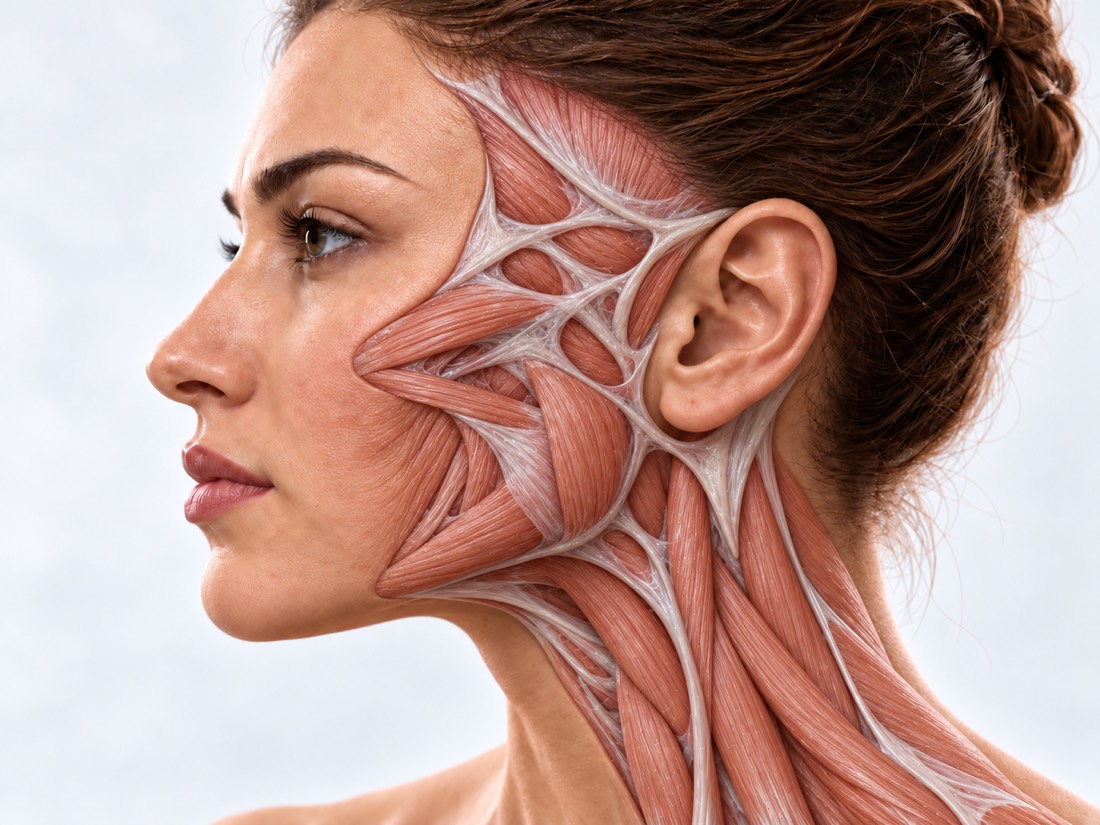
Conceptual visualization: healing of facial skin after a cutCONCEPTUAL VISUALIZATION
What it is
Scar after a facial wound: cut by glass or knife, fall, blow, abrasion, or car accident.
How it changes
Most scars lighten over time; this can take up to 2 years or longer.
When treated
Care — immediately after healing, laser — can be started early, surgery — usually after the scar matures.
Who treats it
Plastic surgeon together with a dermatologist.

Why after an injury
a scar remains.

A permanent scar forms when the wound reaches the deep layer of the skin — the reticular dermis.

A review on post-traumatic scars calls damage to the skin and soft tissues of the face one of the most long-lasting consequences of injury. Such a scar changes not only appearance: it also has psychological effects.

What the scar will look like depends on several factors. On the tension of the skin: to make the scar better, they try to reduce the tension on the wound. On inflammation: if it lasts longer or is more intense, the scar can thicken — becoming hypertrophic or keloid. And if during the remodeling of the scar collagen is destroyed more than it is formed, the scar turns out sunken.

A separate problem in injuries is dirt. If particles of soil or asphalt remain in the abrasions, they can stay in the skin as blue or black spots — a traumatic tattoo.

This is general information. The doctor will tell you what will suit you after the examination.

Types of
scars after injury.

Most scars fade and flatten over time. A reason to show the scar to a doctor is when it does not lighten, thickens, sinks, itches, or hurts.

01

Noticeable color

Scar red, pink, purple, or darker than the surrounding skin and does not lighten.

02

Retracted scar

At the site of the wound there is a depression or groove.

03

A thick scar

Raised and firm, but within the wound boundaries. Such a scar usually gradually flattens, but may itch and pull.

Hypertrophic facial scars
04

Scar larger than the wound

Hard smooth scar extends beyond the wound and does not flatten on its own — this is how a keloid behaves.

Keloid scars on the face
05

Dark spots

Blue or black irregular spots under the skin after a scratch — dirt particles left in the skin.

After which injuries
Scars remain.

The type of wound determines if its edges are even, if there is dirt, and if tissue is missing — hence also the scar treatment plan.

Cuts with glass and knife

Deep wounds with even edges. A deep cut can hit a nerve — then the skin near the wound becomes numb or part of the face does not move.

Abrasions

After falling on asphalt or soil, dirt particles remain in the skin. If they are not carefully removed within 24 hours, a traumatic tattoo may remain.

Bites

A human or animal bite should be shown to a doctor the same day; such wounds are treated according to separate rules.

Consequences of animal bites

Wound inflammation

If inflammation in the wound lasts longer or is stronger, the scar may become hypertrophic or keloid.

When to seek medical advice?

An old scar does not require emergency care: it is treated on a planned basis. But a fresh facial cut, aside from minor scratches, should be shown to a doctor immediately — this determines what the scar will be like.

103 immediately if:

  • bleeding from a wound that does not stop;
  • the blood is bright red and spurts;
  • a deep or large cut on the face;
  • glass or a fragment is stuck in the wound — do not remove it yourself;
  • the skin near the wound is numb or part of the face has stopped moving;
  • stiffness of the jaw appeared after the wound;
  • it has become difficult to swallow;
  • painful cramps or muscle stiffness have appeared;
  • it has become difficult to breathe.

Do not delay a visit to the doctor:

On the same day: soil or dirt remained in the wound after rinsing; you were bitten by a person or an animal; the wound or scar has swollen, is red, increasingly painful, hot to the touch, or oozing pus; after the cut you developed a fever or feel unwell; you are not sure if you are vaccinated against tetanus. Planned: The scar is noticeable, itchy, painful, tight, or just bothers you — make an appointment for a consultation.

As defined,
what to do with the scar.

  1. Conversation

    When and how you were injured, how the wound was closed — with stitches, glue, or strips, whether there was inflammation, how the scar has changed since then.

  2. Review

    Color, thickness, and texture of the scar, whether it is still maturing, whether it pulls the eyelid or lip, whether there are particles of dirt under the skin, how the face moves, and whether sensitivity is preserved.

  3. Photo in standard angles

    For planning and to compare the scar over time.

  4. Examination as needed

    If something can be felt under the scar or there is suspicion of glass — imaging, as prescribed by the doctor.

How we treat
Scars after injuries.

It is impossible to completely remove a scar: the goal is to make it thinner, lighter, and less noticeable. Much is decided at the stage of a fresh wound, and the rest is corrected later on the scar.

01

A fresh wound

The first hours and days.

Wound closure
The wound is rinsed and closed with stitches, strips, or medical glue. An infected wound is sometimes not closed immediately.
Glue or stitches
For simple wounds with even edges and no tension, glue provides the same scar appearance as stitches, with less pain and faster healing. However, wounds under glue separated slightly more often (the difference is small but statistically significant) — this is taken into account when choosing the method.
Dirt in the wound
It is important to thoroughly remove dirt particles from abrasions within 24 hours — otherwise, a traumatic tattoo may remain.
Tetanus and antibiotics
Depending on the wound and vaccinations, a tetanus shot may be needed. Antibiotics are usually not required internally for clean facial wounds.
02

While the scar matures

From healing and the first months.

Silicone
International guidelines consider silicone gel or sheets as the first choice for preventing thick scars. In a review of two studies after closing facial wounds, the gel improved the appearance of the scar when used for at least a month.
Care
Moist healing with petroleum jelly speeds up healing. Massage — only when the wound is completely healed. Protect the scar from the sun for at least a year, with a cream SPF 30 or higher. Onion extract and vitamin E offer little benefit compared to silicone.
Early laser
In a study of 45 patients with traumatic facial scars, fractional CO2 laser treatment was started immediately, 2 weeks, or 4 weeks after suture removal, and scars improved in all three groups without significant differences among them; authors lean towards starting about 2 weeks after suture removal.
Botulinum toxin
Botulinum toxin injections are being studied for the prevention of scars after facial injuries and surgeries. In a meta-analysis of 12 randomized studies (644 patients), it had some effect against thick scars without serious side effects, but higher-quality studies are needed.
03

Scar correction

When the scar remains noticeable.

Laser
An international consensus of 26 dermatologists and plastic surgeons from 13 countries named lasers as the first-line therapy for scars following injuries.
Excision and tissue rearrangement
The scar is excised and sutured again. Z-plasty changes its direction, while W-plasty and "broken line" break a long straight line into short segments.
Lipofilling
Autologous fat is injected under a depressed scar. In a review of 23 studies (1,326 patients) with scars after burns and injuries, scar quality improved according to both patients and doctors.
Traumatic tattoo
Dirt particles in the skin are mostly treated with a special tattoo laser; for particles that may ignite, other methods are chosen.
Injections and camouflage
Depending on the type of scar, treatment may include steroid injections. Special creams and powders (camouflage) help to conceal the scar.
04

Deadlines

Surgery — later
Surgical methods improve mature scars if the right timing is chosen. Most scars lighten over 2 years and longer, so surgery is usually planned when the scar matures.
Nerve — without delay
If a cut has severed the facial nerve, it is desirable to suture it within 72 hours after the injury.
support
If the scar affects your mood, talking to a psychotherapist can also help — tell your doctor about this.

How
we treat it.

Scars from facial injuries and cuts at the Dr. Valikhnovskyi Institute of Surgery are treated under the 'New Face' program. Fractional CO2 laser and IPL — using the clinic's own equipment, scar care is managed by a dermatologist.

CLINIC SERVICE A new face Form, symmetry, facial expressions and functions after injuries, wounds, burns, removal of tumors and congenital changes. View service

What we do for this condition

  • Scar excision — the scar is excised and closed with local tissue so that it becomes thinner and smoother.
  • Flaps from the face and neck — perforator flaps and flaps from adjacent areas close the wound without coarse tension or distortion of the mouth or eye lines.
  • Expander — for large areas: a balloon is gradually filled under the healthy skin nearby, and then the stretched skin is moved to cover the scar area.
  • Lipofilling — microfat and nanofat under the indented scar — for volume, softness, and skin texture.
  • Fractional CO2 laser — to make the scar smoother, softer, and less noticeable; treatment can be started early.
  • IPL — for redness and pigmentation of the scar.
  • Scar care — the dermatologist will choose silicone gel, sheets, or tape and monitor how the scar matures.

Rostislav Valikhnovskyi

Plastic surgeon, candidate of medical sciences, founder of Dr. Valikhnovskyi Institute of Surgery.

Publications by topic

  • "Correction of cicatricial deformation of the frontal area: surgical methods and results of own research" — Hospital Surgery, 2025 (DOI).

How treatment works with us

  1. Photo onlineSend a photo of the scar straight-on and from the side in daylight; indicate when and how you were injured.
  2. ConsultationScar examination, assessment of whether it is still maturing, how the face moves, and whether sensitivity is preserved.
  3. PlanWhat can be done right now — care, laser — and what is better after the scar has matured.
  4. TreatmentLaser, IPL, excision, flaps, or lipofilling — separately or combined.
  5. RecoverySilicone, sun protection, and follow-up check-ups; the final appearance of the scar is assessed after months.

Common
questions

Short answers. What is right for you, the doctor will tell you during the consultation.

Will the scar from a cut disappear completely?

No. The scar does not disappear, but most lighten over time — up to 2 years and longer. Treatment makes it thinner and less noticeable.

When can scar treatment be started?

Care and silicone — immediately after the wound has healed. Laser can be started early: in studies — from suture removal up to 4 weeks after. Surgery is usually planned when the scar matures.

What is better for a fresh cut: stitches or glue?

For simple wounds with even edges and without tension, glue gives the same scar appearance as stitches, and less pain. But wounds under glue separated more often, so the method is chosen by the doctor.

What should you apply to a fresh scar?

After healing — silicone gel or sheets, for at least a month. Protect the scar from the sun for at least a year. Onion extract and vitamin E provide little benefit compared to silicone.

After falling on asphalt, dark spots remained under the skin. What is it?

Most likely, it is a traumatic tattoo — dirt particles in the skin. They are treated with a special laser or other methods; the doctor will say what is suitable after examination.

After cutting the cheek, part of the face does not move. What should you do?

Call 103 or go to the emergency department: a deep cut may have affected the facial nerve, and it is advisable to stitch it within 72 hours.

The scar is red, swollen, and painful. Is this dangerous?

Show it to a doctor the same day, especially if the scar is hot to the touch or oozing pus: it could be an infection.

Sources

17 sources · international guidelines, systematic reviews and the NHS
showCollapse
  1. Updated scar management practical guidelines: non-invasive and invasive measuresJournal of Plastic, Reconstructive & Aesthetic Surgery, 2014doi:10.1016/j.bjps.2014.04.011 ↗
  2. Laser Treatment of Traumatic Scars and Contractures: 2020 International Consensus RecommendationsLasers in Surgery and Medicine, 2020doi:10.1002/lsm.23201 ↗
  3. Traumatic Scars: Evaluation of the Best Timing for Early Intervention With Fractional CO2 Laser Using Optical Coherence TomographyPhotodermatology, Photoimmunology & Photomedicine, 2026doi:10.1111/phpp.70071 ↗
  4. Tissue adhesives for traumatic lacerations in children and adultsCochrane Database of Systematic Reviews, 2002doi:10.1002/14651858.CD003326 ↗
  5. Pediatric Facial Lacerations: Evidence-Based Over-the-Counter Wound Care and Scar Prevention for Clinicians and CaregiversCureus, 2025doi:10.7759/cureus.85909 ↗
  6. Should we be advising patients to use topical silicone gel for wound care following facial laceration suturing in the emergency department?Emergency Medicine Journal, 2025doi:10.1136/emermed-2025-215094 ↗
  7. Improving posttraumatic facial scarsOtolaryngologic Clinics of North America, 2013doi:10.1016/j.otc.2013.06.006 ↗
  8. Scar revision techniques: z-plasty, w-plasty, and geometric broken line closureFacial Plastic Surgery Clinics of North America, 2011doi:10.1016/j.fsc.2011.06.002 ↗
  9. Surgery for scar revision and reduction: from primary closure to flap surgeryBurns & Trauma, 2019doi:10.1186/s41038-019-0144-5 ↗
  10. Traumatic Tattoos: Prevention and TreatmentDermatologic Surgery, 2026doi:10.1097/DSS.0000000000005123 ↗
  11. Botulinum Toxin Type A for Preventing Facial Trauma and Hypertrophic Scars: A Meta-Analysis and Trial Sequential AnalysisJournal of Cosmetic Dermatology, 2025doi:10.1111/jocd.70501 ↗
  12. Management of facial nerve traumaCurrent Opinion in Otolaryngology & Head and Neck Surgery, 2024doi:10.1097/MOO.0000000000000976 ↗
  13. Effectiveness of Autologous Fat Grafting in the Treatment of Scars: A Systematic Review and Meta-AnalysisAesthetic Plastic Surgery, 2024doi:10.1007/s00266-024-04131-w ↗
  14. Correction of cicatricial deformation of the frontal area: surgical methods and results of own researchHospital surgery, 2025doi:10.11603/2414-4533.2025.2.15396 ↗
  15. Cuts and grazesNHS, 2026nhs.uk/conditions/cuts-and-grazes ↗
  16. ScarsNHS, 2023nhs.uk/conditions/scars ↗
  17. TetanusNHS, 2026nhs.uk/conditions/tetanus ↗

The figures on the page are from these sources.

VALIKHNOVSKI SURGERY PARTNERS

Scar after injury
Keeps bothering you?

Send a photo of the scar straight on and from the side in daylight. The doctor will say what can be done now and what — later.

Call Send an enquiry
ONLINE ENQUIRY

Tell us how we can help.

Leave your contact details and briefly describe the situation. A coordinator will contact you to agree on the next step.

Preferred contact method