Shrapnel scars
Many small scars of varying depth scattered over the face and neck.
 Discuss your case
Scar correction after facial or neck injury is needed when traces of shrapnel, rough sutures, indented areas, or scars that pull the neck or eyelid remain after gunshot, shrapnel, or mine-explosive injuries. They are treated in stages: laser, care, and surgeries.
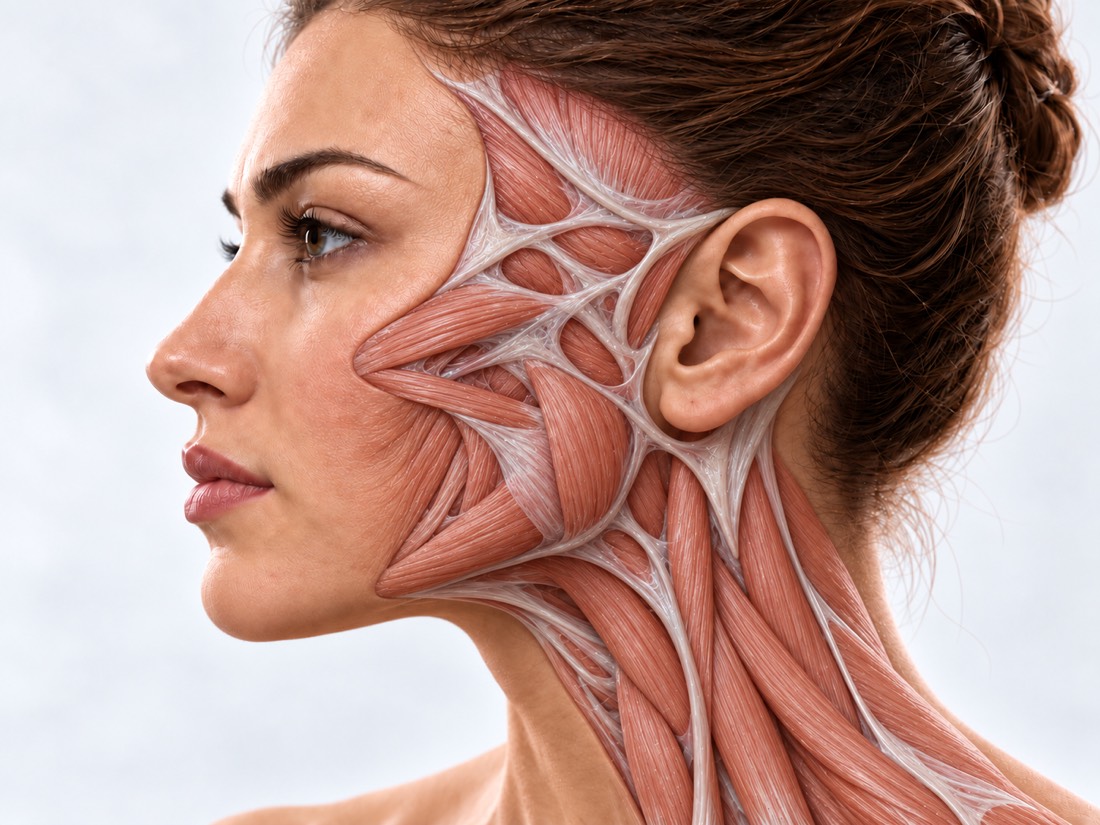 CONCEPTUAL VISUALIZATION
Blast injuries are high-energy injuries: they can cause significant damage to soft tissues. At the Lviv Military Medical Center after 2022, wounds from large shell fragments are mostly treated; such fragments often tear out areas of facial bones along with the overlying soft tissues.
Therefore, the scars after injury are different from those after a regular cut. They can be numerous and of various depths: from traces of small shrapnel to large scars in areas of lost tissue. Added to these are scars from surgical wound treatment, staged operations, and on the neck — from airway surgeries, if they were performed.
Scars on the neck and other movable areas can become contractures — pulling the head, chin, or corner of the mouth. And explosive particles left in the skin give blue or black spots — traumatic tattooing.
Facial scars are also a psychological burden. In a review of 21 studies, a violent cause of a scar was one of the factors associated with anxiety and depression. Therefore, it is worth talking about your mood with a doctor just as you would about the scar itself.
This page is only about scars. Bone and tissue defects, facial expressions, and fragments are described on separate pages. This is general information. What will suit you specifically, the doctor will tell after an examination.
Often, several types of scars combine in one person. They may itch, hurt, or interfere with movement — it is worth telling your doctor about this.
Many small scars of varying depth scattered over the face and neck.
Wide, raised, or uneven scars after surgical wound treatment and operations in a hospital.
The scar has sunken where there is a lack of tissue under the skin; the contour of the face has changed.
Consequences of gunshot wounds to the faceBlue or black irregularly shaped spots — explosion particles remaining in the skin.
The neck does not fully turn, the chin is pulled down, the eyelid or lip is pulled.
Cicatricial deformation of the faceA hard spot can be felt under the scar, the area hurts or swells — possibly there is a fragment there.
Shrapnel in the face and neckIt depends on how and with what the injury was caused, how many scars there are, how deep they are, and whether there is enough healthy skin around.
High-energy injuries can damage large areas of soft tissue — resulting in more scars.
Debris and particles from the explosion remain in the wound. Their removal is one of the main tasks in treating a fresh wound; what remains may cause a traumatic tattoo.
For large injuries, reconstruction is planned in stages, and each stage leaves its own scars.
On the neck, near the mouth and eyelids, the scar tightens and can become a contracture.
If the injury was accompanied by a burn, the scars are treated taking it into account as well.
Scars after facial burnsMature scars after emergency treatment usually do not require immediate action: this is planned treatment. But while the wounds are still healing, some symptoms require immediate assistance.
Immediately, without delay: If you have thoughts of ending your life or harming yourself, do not stay alone with them — tell your loved ones and contact a 24-hour psychological support line or a doctor immediately; if there is an immediate threat — call 103. On the same day: The wound or scar is swollen, red, increasingly painful, hot to the touch, or oozing pus; you have a fever or feel unwell, but the signs on the 103 list are not present; the scar prevents you from fully closing your eye, and the eye is very red, painful, sensitive to light, or your vision has changed. In the coming days or weeks: Thoughts or memories of the injury won't go away, appear in dreams, or you avoid people or places — see a doctor or psychologist, even if months have passed since the injury. Planned: The scar pulls, interferes with turning your head, opening your mouth, or closing your eye, it itches, hurts, or you are concerned about its appearance — make an appointment for a consultation.
When and how it was injured, which surgeries have already been done; hospital discharge summaries, operation reports, CT scans.
How many scars and what type, whether they are still maturing, whether they pull the neck, eyelid, or lip, how the face moves, whether there are particles in the skin.
For planning stages and to compare scars over time.
If something can be felt under the scar or it hurts — an examination prescribed by a doctor.
It is not possible to completely remove scars, but they can be made thinner, softer, and less noticeable, and tension can be reduced. After injuries, this usually involves several stages combining laser, care, and surgeries.
From wound healing.
The main method for many post-traumatic scars.
When the scar pulls, is coarse, or is depressed.
Scars after facial and neck injuries are treated at the Valikhnovskyi Surgery Institute in two directions — "Surgery of Gunshot Injuries" and "New Face." The clinic performs operations for Ukrainian Armed Forces servicemen with funding from charitable foundations.
Plastic surgeon, candidate of medical sciences, founder of Dr. Valikhnovskyi Institute of Surgery.
Short answers. What is right for you, the doctor will tell you during the consultation.
Usually — when the scars mature. Laser and care can be started earlier. Scars that restrict movement of the neck, mouth, or eyelid are usually treated first.
Completely — no, the scar does not disappear. But laser can make small scars smoother and less noticeable, and dark spots from explosion particles are treated separately.
After severe injuries, treatment is usually staged: several laser sessions, sometimes one or more surgeries. The doctor explains the stage plan after the examination.
An international consensus of 26 specialists calls lasers a first-line therapy for scars and contractures after injuries. Whether a laser is suitable for you will be told by a doctor after an examination.
It could be a fragment. Show the area to a surgeon; if it is swollen, red, hot, or oozing pus — the same day.
A doctor or psychologist. Recurrent severe memories, dreams, and avoidance of people or places may be signs of PTSD, and psychotherapy helps.
Yes. The clinic performs surgeries for servicemen of the Armed Forces of Ukraine funded by charitable foundations. Bring your military ID and hospital discharge papers to the consultation.
The figures on the page are from these sources.
Send photos of your face and neck along with hospital discharge summaries. The doctor will tell you where to start and approximately how many stages will be needed.
Leave your contact details and briefly describe the situation. A coordinator will contact you to agree on the next step.