CONDITION / JAWS, MOUTH AND NECK

Destruction of the head of the jaw joint.

TMJ destruction is a condition in which the head of the mandible in the temporomandibular joint gradually dissolves or breaks down after arthritis, trauma, or surgery. The branch of the jaw shortens, the bite and profile change. When other treatments do not help, the joint is replaced with a prosthesis.

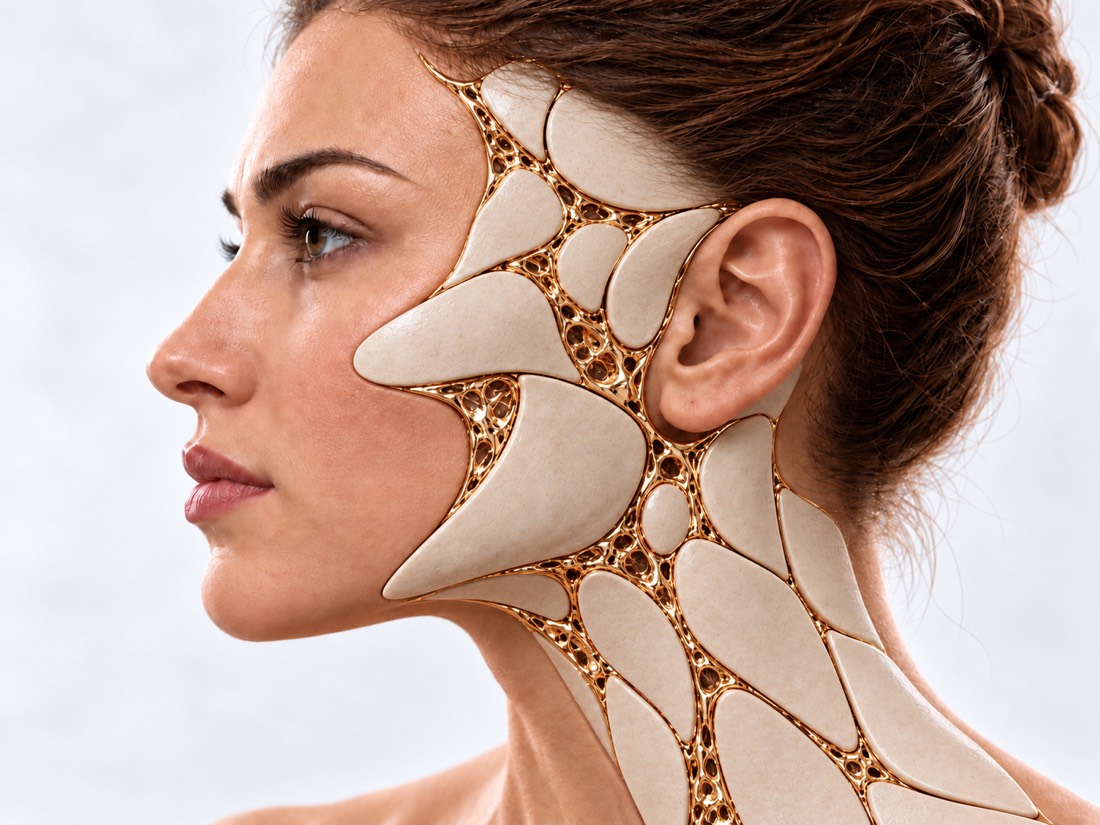
Conceptual visualization: mandibular jointCONCEPTUAL VISUALIZATION
What it is
The head of the lower jaw in the joint is resorbed or destroyed, the branch of the jaw becomes shorter.
Causes
Arthritis, trauma, infection, jaw surgery; happens for no apparent reason.
Symptoms
The bite changes, the chin moves back, there is pain; in the beginning, nothing often hurts.
Who treats it
A maxillofacial surgeon together with an orthodontist, and in case of arthritis - with a rheumatologist.

What is
destruction of the head.

The temporomandibular joint is a joint in front of the ear, where the head (condyle) of the lower jaw moves in the fossa of the skull. When the head is resorbed or destroyed, it becomes lower and smaller, and the branch of the jaw becomes shorter with it.

Consequences — deformation of the jaw, incorrect bite, pain, headache and even breathing disorders. If destruction begins before the end of growth, both the branch and body of the jaw shorten, and the lower part of the face lengthens.

The insidiousness is that the process is often almost painless: with arthritis, even the visible destruction of the joint on the pictures is often without symptoms.

This page is about a collapsing joint. If the joint has fused and the mouth does not open, it is ankylosis; if there is pain and clicking without destruction of the bone, it is joint dysfunction.

This is general information. The doctor will tell you what will suit you after the examination.

How to notice
destruction

Changes grow gradually, so they are often first noticed by the orthodontist or the patient himself - by the bite and profile.

01

The bite has changed

The teeth close differently than before: an incorrect bite is one of the consequences of the destruction of the head.

02

The chin recedes

The pictures show a lower head and shorter jawline, a profile with a receding chin.

Distal bite
03

pain

Pain in the joint in front of the ear and headache. Sometimes it is difficult to open and close your mouth and eat normal food.

04

Breathing

Among the consequences of the destruction, the reviews also mention a violation of the patency of the respiratory tract.

Why the head?
is collapsing

There are several reasons, and the treatment depends on them. One review divides them into four groups: resorption in adolescents, inflammatory arthritis, autoimmune diseases, and other end-stage joint damage.

Idiopathic resorption

A rare aggressive form of joint damage without a known cause, most often in teenage girls and young women. Possible factors include female sex, estrogen levels, head shape, and previous jaw surgery.

Arthritis

In rheumatoid and juvenile idiopathic arthritis, the jaw joint is affected in 40–90% of patients, although often without symptoms.

After operations on the jaws

After mandibular protrusion, resorption occurs more often in young people, in women, and in people with a steep angle of the lower jaw; after surgery on both jaws, the risk appears to be higher.

Injury, infection, wear and tear

Among the causes of joint damage are inflammatory and degenerative arthritis, trauma, infection, and complications of operations.

Fractures of the condylar process

Not to be confused with ankylosis

If the joint is not destroyed, but grows with the skull and the mouth stops opening, this is a separate condition.

Ankylosis of the joint

When to seek medical advice?

The destruction of the head develops gradually and usually does not require emergency care. But if the bite or profile changes noticeably over the months, do not postpone the consultation. Emergency situations occur mostly after surgery.

103 immediately if:

  • it is very difficult to breathe: a person suffocates, chokes or cannot utter words;
  • breathing became very frequent;
  • lips or skin become very pale, bluish, gray or mottled;
  • the person is confused, speaks indistinctly or does not make sense;
  • a rash appeared that does not fade when pressed;
  • bleeding does not stop after surgery;
  • after surgery, the swelling in the mouth or neck increases rapidly, it becomes difficult to swallow or breathe.

Other levels of urgency:

After the operation - immediately to the surgeon who operated, and if it does not work - to the waiting room: the pain intensifies, the seam becomes red or swollen, pus comes out of the wound, or the temperature rises. The same day to the doctor: the jaw unexpectedly jammed or the mouth stopped opening; unable to eat or drink. Planned: the bite gradually changes, the chin recedes back, it hurts in front of the ear; a child or an adult with arthritis — to examine the jaw joint.

As defined,
what about the joint

  1. Discussion and review

    How the bite and profile have changed, whether there is arthritis, whether there have been injuries and operations on the jaws. The doctor measures the opening of the mouth.

  2. CT

    Shows the height of the head and branches of the jaw and the shape of the joint; according to the CT scan, then they plan the operation.

  3. MRI

    It helps to find out the cause of destruction and choose treatment. In rheumatoid arthritis, joint damage is confirmed by contrast-enhanced MRI.

  4. Rheumatologist and orthodontist

    If the cause is arthritis, the underlying disease is treated first. Children with juvenile arthritis are advised to have their jaw joint examined every year.

How we treat
destruction of the head.

There is no one-size-fits-all approach: reviews emphasize that there is little evidence for causes and treatments, and that the plan depends on the cause and severity. First — treatment without surgery; surgery is considered when it does not help.

01

Without surgery

In the early stages and when the cause is arthritis.

Treatment of the main disease
With arthritis of the jaw joint, conservative treatment (basic antirheumatic therapy, local measures) does not help less than 10% of patients (2022 guideline). For temporary relief, joint lavage or arthroscopy can then be used; a corticosteroid injection into the joint — only once and only when nothing else helps.
Mouthguards and orthodontics
Occlusive mouthguards, orthodontic treatment, and medications are among the options for idiopathic resorption.
02

Jaw operations

When the deformity interferes with chewing, breathing or changes the face.

Jaw repositioning (orthognathic surgery)
Corrects bite and profile. But existing resorption affects the choice of timing and plan of surgery, and resorption after surgery often returns the deformity (review of 10 articles, 180 patients).
Removal of the head with recovery
Removal of the affected head with reconstruction with own bone (rib) or an artificial joint appears to be the most stable option for idiopathic resorption (review of 40 studies, 1399 patients), although the level of evidence is low.
Prosthesis together with repositioning of the jaws
A 2018 review considers both approaches acceptable—jaw repositioning with or without a joint prosthesis; the key is to correctly determine what suits whom.
03

Artificial joint (endoprosthesis)

Both the socket and the head are replaced when other methods have failed (NICE).

What gives
In a review of 11 studies (569 patients), after prosthetics, the mouth opened wider, it hurt less, and the quality of life improved; lateral movements of the jaw often remained smaller than in healthy people. The certainty of the evidence is very low.
How much does it serve?
According to a meta-analysis of 6 studies (320 patients), prostheses were preserved in 97% (certainty of evidence is very low); in most studies, the prosthesis was lost in the first 6 months due to infection. According to another review, five-year retention is more than 90%.
Risks
Most often - weakness or paralysis of the branches of the facial nerve (7.8%), impaired sensitivity (1.8%), formation of excess bone around the prosthesis (1.0%) and infection (0.7%) - a meta-analysis of 28 studies.
Repeat operations
2,247 prostheses required revisions with a frequency of 1.19 per 100 prosthesis-years; the most common reason is excess bone around the prosthesis.
Standard or individual
Results were similar for mouth opening, pain, nutrition, and function (meta-analysis of 20 studies, 1,262 patients). Individual prostheses are more often placed when the anatomy is greatly changed and after several operations.
Comparison with other operations
There are few direct comparisons: the 2025 review found one study (prosthetic versus autologous padding) and found no difference between the groups.
In children
Prostheses are rarely placed in children: in a review of 14 patients up to the age of 13, pain decreased, but the jaw after prosthetics grew to a limited extent.

How
we treat it.

The surgical part of the treatment of the destruction of the joint head at Dr. Valikhnovskyi's Institute of Surgery is undertaken by the "New Face" department, where the lower jaw and joint are restored. Arthritis is treated by a rheumatologist, and teeth alignment by an orthodontist.

CLINIC SERVICE A new face Form, symmetry, facial expressions and functions after injuries, wounds, burns, removal of tumors and congenital changes. View service

What we do for this condition

  • CT and 3D planning — based on computer tomography, a three-dimensional model of the jaw is built; the undamaged side is mirrored on the affected side and recovery is planned in advance.
  • Joint implant — an artificial joint instead of the destroyed head.
  • Individual implants — based on a 3D model made of titanium or PEEK, plates or parts of the jaw are made exactly according to the patient's anatomy.
  • Surgical templates — printed guides that the surgeon applies to the bone to make a cut at the desired angle.
  • Fibula flap — tibia bone with its own vessels to reproduce the jaw when a large area of bone is lost.

Rostislav Valikhnovskyi

Plastic surgeon, candidate of medical sciences, founder of Dr. Valikhnovskyi Institute of Surgery.

How treatment works with us

  1. Pictures onlineSend a CT scan or MRI, if available, a photo of the face and bite - the doctor will pre-evaluate the situation.
  2. ConsultationExamination, measurement of mouth opening, CT scan; if necessary — MRI and consultation of a rheumatologist.
  3. PlanIs treatment without surgery sufficient, or is surgery on the jaws or a joint prosthesis necessary; sequence of stages with an orthodontist.
  4. SurgeryUnder general anesthesia, according to the 3D plan.
  5. RecoverySoft food, jaw exercises and check-ups for a while.

Common
questions

Short answers. What is right for you, the doctor will tell you during the consultation.

Is surgery always necessary?

No. With arthritis of the jaw joint, conservative treatment does not help less than 10% of patients, and open surgery is considered in less than 1% (2022 guideline). With idiopathic resorption, the plan depends on the severity.

How is it different from joint dysfunction?

Dysfunction is pain, clicking, limited opening, and it usually goes away on its own. When destroyed, the bone itself changes: the head and branch of the jaw shorten, the bite and profile change.

Is it possible to fix the bite while the head is collapsing?

Resorption affects the timing and planning of surgery, and if it persists after surgery, the deformity often returns. Therefore, the plan is drawn up by the surgeon together with the orthodontist.

How long does an artificial joint last?

According to a meta-analysis of 6 studies, prostheses were preserved in 97%, according to another review, five-year preservation was more than 90%. In most studies, the prosthesis was lost in the first 6 months due to infection.

What are the risks of prosthetics?

Most often — weakness or paralysis of the branches of the facial nerve (7.8%) and impaired sensitivity (1.8%); less often - excess bone around the prosthesis and infection.

Are prostheses put on teenagers?

Rarely. In a review of 14 children up to 13 years of age, the pain decreased, but the jaw after prosthetics grew to a limited extent. Decisions are made individually.

Why a rheumatologist if the jaw hurts?

If arthritis is destroying the joint, early treatment of the underlying disease is important for a good outcome. The rheumatologist conducts this part of the treatment, the surgeon - his.

Sources

20 sources · reviews, meta-analyses, NICE and NHS guidelines
showCollapse
  1. Condylar resorption of the temporomandibular joint: how do we treat it?Oral and Maxillofacial Surgery Clinics of North America, 2015doi:10.1016/j.coms.2014.09.005 ↗
  2. Idiopathic Condylar Resorption: What Should We Do?Oral and Maxillofacial Surgery Clinics of North America, 2020doi:10.1016/j.coms.2019.09.001 ↗
  3. Idiopathic condylar resorption: A systematic review of etiology and managementOral Surgery, Oral Medicine, Oral Pathology and Oral Radiology, 2020doi:10.1016/j.oooo.2020.07.008 ↗
  4. Management-related outcomes and radiographic findings of idiopathic condylar resorption: a systematic reviewInternational Journal of Oral and Maxillofacial Surgery, 2015doi:10.1016/j.ijom.2014.09.005 ↗
  5. Surgical Management of Idiopathic Condylar Resorption: Orthognathic Surgery Versus Temporomandibular Total Joint ReplacementOral and Maxillofacial Surgery Clinics of North America, 2018doi:10.1016/j.coms.2018.05.004 ↗
  6. Condylar resorption following mandibular advancement or bimaxillary osteotomies: A systematic review of systematic reviewsJournal of Stomatology, Oral and Maxillofacial Surgery, 2022doi:10.1016/j.jormas.2022.03.008 ↗
  7. Management of condylar resorption before or after orthognathic surgery: A systematic reviewJournal of Cranio-Maxillofacial Surgery, 2019doi:10.1016/j.jcms.2019.03.012 ↗
  8. Clinical practice guideline: The diagnosis and treatment of rheumatoid and juvenile idiopathic arthritis of the temporomandibular jointDeutsches Ärzteblatt International, 2022doi:10.3238/arztebl.m2021.0388 ↗
  9. Outcomes of total temporomandibular joint replacement: a systematic reviewOral and Maxillofacial Surgery, 2026doi:10.1007/s10006-026-01648-z ↗
  10. Survival of temporomandibular total joint replacement: A systematic review and meta-analysisJournal of Oral Rehabilitation, 2024doi:10.1111/joor.13635 ↗
  11. Complications of total temporomandibular joint replacement: a systematic review and meta-analysisInternational Journal of Oral and Maxillofacial Surgery, 2023doi:10.1016/j.ijom.2022.10.009 ↗
  12. Reasons for failure of total temporomandibular joint replacement: a systematic review and meta-analysisInternational Journal of Oral and Maxillofacial Surgery, 2022doi:10.1016/j.ijom.2021.12.012 ↗
  13. A Comparison of Clinical Follow-Up of Different Total Temporomandibular Joint Replacement Prostheses: A Systematic Review and Meta-AnalysisJournal of Oral and Maxillofacial Surgery, 2018doi:10.1016/j.joms.2017.08.022 ↗
  14. Effects of total temporomandibular joint replacement with alloplastic prosthesis — a systematic reviewActa Odontologica Scandinavica, 2025doi:10.2340/aos.v84.43641 ↗
  15. Alloplastic TMJ replacement in the skeletally immature patient — A systematic reviewJournal of Cranio-Maxillofacial Surgery, 2024doi:10.1016/j.jcms.2024.03.028 ↗
  16. Total prosthetic replacement of the temporomandibular joint (HTG352)NICE, 2014nice.org.uk/guidance/htg352 ↗
  17. Temporomandibular disorder (TMD)NHS, 2023nhs.uk/conditions/temporomandibular-disorder-tmd ↗
  18. Shortness of breathNHS, 2024nhs.uk/symptoms/shortness-of-breath ↗
  19. SepsisNHS, 2026nhs.uk/conditions/sepsis ↗
  20. Cuts and grazesNHS, 2026nhs.uk/conditions/cuts-and-grazes ↗

The figures on the page are from these sources.

VALIKHNOVSKI SURGERY PARTNERS

The bite has changed
or a profile?

Send a CT scan or MRI, if available, and a photo of your face. The doctor will tell you what is happening with the joint and what can be done.

Call Send an enquiry
ONLINE ENQUIRY

Tell us how we can help.

Leave your contact details and briefly describe the situation. A coordinator will contact you to agree on the next step.

Preferred contact method