Nothing bothers you
A person learns about the fragment only from an X-ray: there is no pain, the arm or leg works as usual.
 Discuss your case
Fragments and foreign bodies in tissues — shrapnel, bullets or their fragments, glass, wood, or pebbles remaining in the muscles and under the skin of the torso, arms, or legs after an injury. It is not necessary to remove every fragment — this is decided after an examination and CT scan.
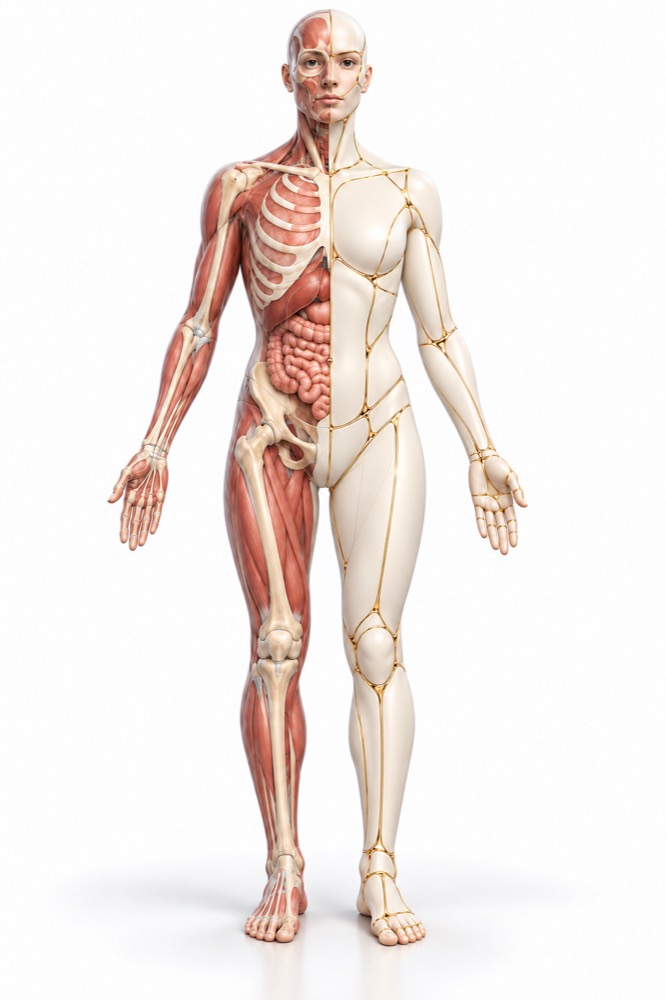 CONCEPTUAL VISUALIZATION
Doctors call foreign bodies anything that is foreign to the body and has gotten stuck in the muscles or under the skin after an injury. After explosions, these are primarily metal fragments: in a study of 20 injured soldiers, 93% of the fragments in the images were metal (889 out of 958), and most often the trunk and arms were affected (45% of the injured).
Other types also occur: glass, wood, pebbles, plastic. Glass and wood are often missed during examination and on a regular X-ray. Around any foreign body, the body forms inflammatory tissue, trying to isolate it.
Thus, the surgeon decides not how to remove all the fragments from the arms, legs, or trunk, but which of them are truly worth removing. In the same study of injured soldiers, only 3% of the fragments were removed, and these were not necessarily the largest or most superficial ones.
This is general information. The doctor will tell you what will suit you after the examination.
Complications can be early or late: a fragment may not cause trouble for a long time, and then become inflamed or start to hurt.
A person learns about the fragment only from an X-ray: there is no pain, the arm or leg works as usual.
A hard mass can be felt under the skin, it hurts during movement or pressure. Persistent pain at the site of the bullet is one of the reasons to remove it.
The skin over the fragment becomes red and swollen, pus is released, an old scar or wound opens again. Among complications of foreign bodies, infection occurs more often than others.
Fire woundFragment in or near a joint: the joint hurts, swells, and moves worse. Lead from a bullet in the joint can cause its inflammation.
Fragment near a nerve: fingers become numb, the hand or foot weakens. If this appeared immediately after a fresh wound — call 103.
Hand nerve injuryIrritability, headache, memory deterioration, abdominal and joint pain, tingling in the limbs. In a study of 45 wounded people with bullet fragments, such complaints occurred more frequently than in people without fragments.
Fragments in the face and neck have their specific features — a separate page is dedicated to them.
Shrapnel in the face and neckThe material of the fragment determines whether it is visible on an image, whether it is prone to infection, and whether MRI is safe.
Fragments of shells, mines, and drones. Among 53 wounded people in the war in Ukraine who were treated in a Spanish hospital, 83% were injured by an explosion.
Bullets and their fragments may contain lead, and some military bullets may also contain steel or nickel; this is important for MRI.
An explosion or impact drives them into the wound along with shrapnel. They are easily missed during examination and on a standard X-ray.
Along with the fragment, dirt and microbes enter the wound. In the same 53 injured, wound infection was associated with foreign bodies in the tissues, damaged bone, and lack of skin.
If the fragment has been in the hand, leg, or torso for a long time and does not cause any problems, usually a scheduled visit is enough. A fresh wound, signs of sepsis, or tetanus require immediate assistance.
On the same day: The skin around the fragment is hot, swollen, red, increasingly painful, or pus is flowing from the wound; you have a fever, chills, or feel unwell; dirt or soil remains in the wound that cannot be washed out; the wound is fresh, and you are not sure you are vaccinated against tetanus. In the coming days: Numbness or weakness gradually appears near an old fragment; the joint in which or near which the fragment lies hurts and moves worse. Planned: A fragment can be felt under the skin, it is painful, interferes with movement, or simply worries you — come to a surgeon with a CT scan, and together you will decide whether to remove it. If fragments remain in the body after a gunshot wound, ask the doctor if you should have your blood tested for lead.
When and with what you were injured, which surgeries and fragment removals have already been done, what is bothering you now; take hospital discharge summaries and discs with images.
The surgeon assesses scars, indurations, signs of inflammation, joint movements, sensitivity, and strength.
For deep fragments, a CT scan is required: it shows where the fragments are located and how close they are to joints and blood vessels. If a fragment is less than 5 cm from a joint, the doctor checks whether the joint capsule is damaged.
Shallow fragments are visible on ultrasound regardless of the material — whether metal, glass, or wood. In a meta-analysis, ultrasound detected an average of 72% of foreign bodies in soft tissues.
In a laboratory study of 29 military and police bullets, 8 — made of steel or nickel — shifted significantly in a magnetic field. Therefore, MRI for metal fragments is performed only after a risk assessment by a radiologist. When undergoing an MRI of any body part, inform the staff about any fragments.
If fragments of bullets remain in the body, the doctor may prescribe a blood test for lead and repeat it.
There is little evidence that fragments must necessarily be removed. Research has not found grounds to routinely remove all bullets — they are removed based on indications. The surgeon explains what the operation will achieve and what risks it entails before you agree.
When a fragment is already causing harm or threatens to do so.
When searching for and removing the fragment causes more harm than the fragment itself.
Fragments and foreign bodies in the trunk and limb tissues are treated at the Doctor Valikhnovskyi Institute of Surgery in the "Surgery of Gunshot Injuries" department. The clinic decides whether to remove the fragment, removes it, and restores the tissues; if the lead level is high, its treatment is managed by a specialized doctor.
Plastic surgeon, candidate of medical sciences, founder of Dr. Valikhnovskyi Institute of Surgery.
Short answers. What is right for you, the doctor will tell you during the consultation.
No. Fragments are removed if they are in a joint, on the palm or sole, as well as those that cause pain, inflammation, lie near a nerve, or raise blood lead levels. Others can be left and monitored. The final decision is made after an examination and CT scan.
First, the risk must be assessed by a radiologist, as fragments made of steel or nickel can be moved by the magnet. To locate fragments in the hand, leg, or torso, a CT scan is usually performed. On the MRI form, you must indicate that there is metal in the body.
Lead poisoning from bullet fragments is rare and may not appear immediately but after months or years. The risk is higher if there are multiple fragments, a fracture, or a fragment in a joint.
There are no universal rules. According to a meta-analysis, with fractures or multiple fragments, tests are done every 3 months during the first year; after that — as the doctor advises.
See a surgeon: fragments in a joint are usually removed because lead from a bullet can cause joint inflammation.
Consult a surgeon the same day: among complications of foreign bodies, infection occurs most often. A fragment around which there is inflammation is usually removed.
If the wound is fresh and you are not sure you are vaccinated, see a doctor the same day: they will check and, if necessary, administer the vaccine.
The figures on the page are from these sources.
Send the CT, discharge summaries, and photos. The surgeon will advise whether the fragment needs to be removed and how to do it.
Leave your contact details and briefly describe the situation. A coordinator will contact you to agree on the next step.