Hematoma
Blood accumulates under the skin: the face or neck area swells, hardens and hurts.
 Discuss your case
Complications after a facelift are problems that go beyond normal healing after a facelift: a hematoma, dead skin, nerve damage, rough scarring, or a displaced earlobe. They are treated even when the operation was performed in another clinic.
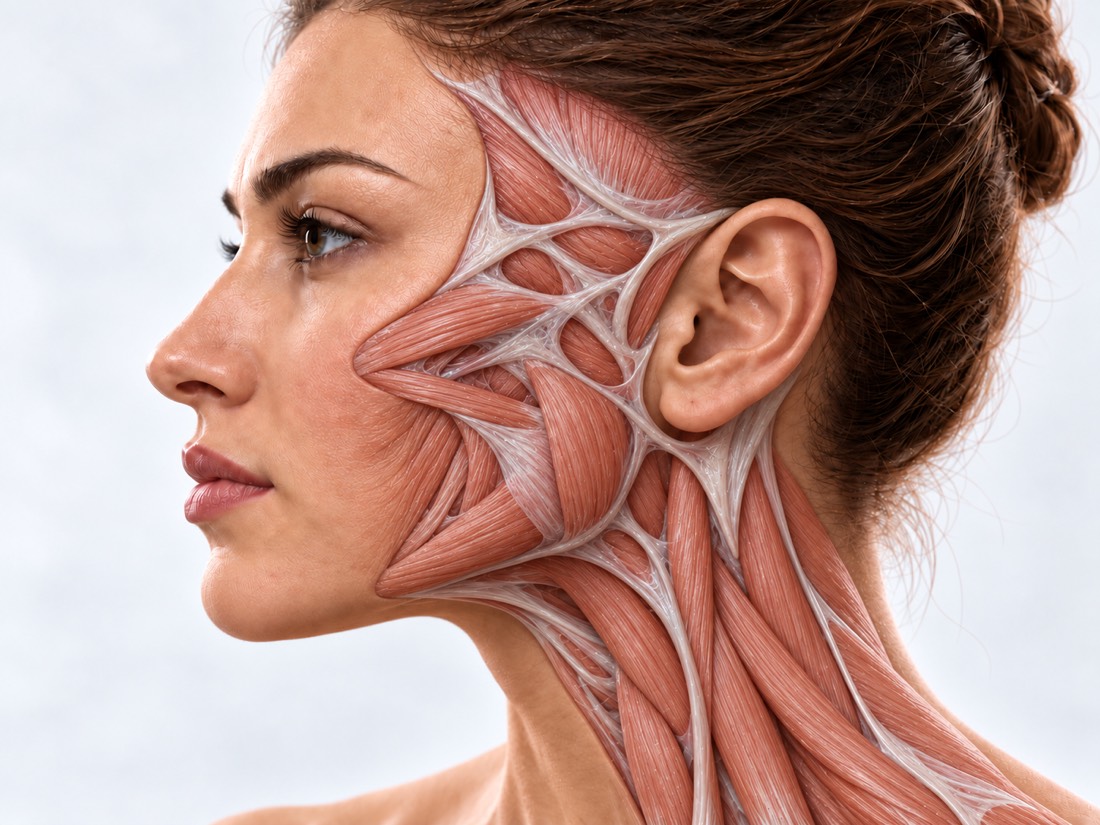 CONCEPTUAL VISUALIZATION
A facelift, or face lift, is an operation in which the skin of the lower part of the face and neck is tightened and stitched in a new position. The incisions are made on the temples, in front of the ear, under the lobe and behind the ear.
Some of the changes after surgery are normal healing. According to the NHS, facial swelling and numbness can last for weeks or months, bruising for at least 2 weeks and the final appearance taking 6-9 months.
A complication is something that goes beyond these: hematoma, dead skin, infection, nerve damage, rough scarring, hair loss around the scars, displaced earlobe. In general, they happen infrequently.
If the first operation was performed in another clinic, this is not an obstacle: the doctor evaluates what is available now and draws up a treatment plan.
This is general information. The doctor will tell you what will suit you after the examination.
Symptoms depend on the type of complication. Here are the ones that are contacted most often.
Blood accumulates under the skin: the face or neck area swells, hardens and hurts.
The skin area darkens and dies, the wound does not heal for a long time.
Skin necrosis after surgeryThe skin of the face or ear does not feel touch, the corner of the mouth or eyebrows move worse than before the operation.
Paralysis of the facial nerveScars near the ear or on the temples are wide, thick, red, or tighten the skin.
Scars after operations on the faceThe lobe was pulled down and forward, and it seemed to be glued to the cheek. This deformity is called "pixie ear".
The growth line on the temples or sideburns has risen, the hair has thinned near the scars.
Part of the risks depends on the person himself, part on the technique of the operation and how the first days after it passed.
High blood pressure after surgery, blood-thinning medications, aspirin, or anti-inflammatory pain relievers increase the risk of hematoma.
Hematoma occurs more often in men: in a cohort of 11,300 patients, the risk was 3.9 times higher.
Smoking damages the small vessels of the skin. In a study of 83 facelifts, dead skin was more common in smokers who did not quit after surgery.
Accumulation of blood under the skin can cause long-term swelling of the face and death of the skin.
When the skin is pulled down and forward, the earlobe shifts and "sticks" to the cheek.
When a facelift is combined with other operations, there are more serious complications: in a cohort of 11,300 patients, up to 3.7% versus 1.5% after a single facelift.
If the operation was a long time ago and you are concerned about scars, earlobes or the shape of the face, this is a planned situation, it usually does not require emergency care. If the complication has just appeared, and there are no signs listed for 103, first contact the surgeon who operated on you. Sudden facial contortion is not the same as facial weakness immediately after surgery: it can be a sign of a stroke, so call 103.
On the same day: to the surgeon who operated, or if this is not possible - to any surgeon, if the skin around the wound darkens, turns blue or black, the wound is red, hot, pus flows from it, the stitches have come apart, the temperature has risen to 38 °C and above, or one leg hurts and is swollen. In the coming days: numbness or weakness of facial expressions, which was noticed immediately after the operation and which does not increase, is most often a temporary damage to the nerve branch; tell the surgeon about it. Planned: scars, earlobes, hair, asymmetry — the final appearance takes 6–9 months, but you can see a doctor even earlier.
When, where and what kind of surgery was done, how the first weeks passed; statement and photo before the operation, if any.
The surgeon evaluates the skin, scars, earlobes, hairline and facial muscle movements.
If there is numbness or weakness, assess which area is affected and to what extent.
Ultrasound to look for blood or fluid accumulation; tests if there are signs of infection.
Treatment depends on what exactly happened and how much time has passed. Some of the changes pass by themselves, some are treated without surgery, and repeated interventions are planned when the tissues have healed.
Acute complications.
Numbness and weakness of facial expressions.
Planned corrections after healing.
Complications after a facelift are treated at Dr. Valikhnovskyi's Institute of Surgery in the direction of "Treatment of complications of aesthetic operations" - in particular, when the first operation was performed in another clinic.
Plastic surgeon, candidate of medical sciences, founder of Dr. Valikhnovskyi Institute of Surgery.
Short answers. What is right for you, the doctor will tell you during the consultation.
Yes. The doctor assesses what is now and makes a plan. Take a statement from that clinic and a photo before the operation, if you have them.
Not necessarily. According to the NHS, swelling and numbness after a facelift can last for weeks or months, and stiffness usually resolves within 6 weeks. If the swelling grows rapidly on one side, is tense and painful, it may be a hematoma: call 103, and then inform the surgeon who operated.
Most often yes. In a systematic review, 70% of patients recovered completely within six months without surgery; 10% of violations remained. How long to wait and whether treatment is necessary, the doctor will tell after the examination. If the face is crooked suddenly, and not immediately after the operation, call 103.
Usually after healing: the final look after a facelift takes 6-9 months. The doctor will tell you what to do and when during the examination.
Yes. It is more complicated, because the tissues are changed after the first operation, but according to the available data, the overall frequency of complications is comparable to the first operation; temporary nerve damage in separate series occurred more often.
High blood pressure, blood thinners, aspirin, and anti-inflammatory pain relievers increase the risk; hematoma occurs more often in men.
Yes, smoking damages the small blood vessels of the skin. In one study, dead skin was more common in smokers who did not quit after surgery.
The figures on the page are from these sources.
Send a photo of your face and a statement from the clinic where you were operated on. The doctor will tell you what can be fixed and when.
Leave your contact details and briefly describe the situation. A coordinator will contact you to agree on the next step.